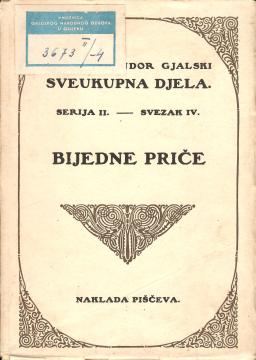
Bijedne priče
Gjalski's Miserable Stories (1913) is a collection of short prose pieces that examine the silent misery and fragile hope of "little" people under a magnifying glass; the elegance of style and gentle irony reveal the conflict between desire, duty, and a se
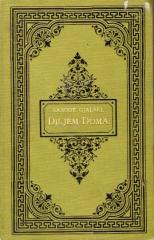
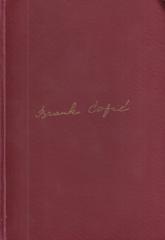
Miser Stories by Ksaver Šandor Gjalski (Collected Works, Series II, Volume IV) opens a cycle of short stories that, from the opening “Approach” to the closing “Hope(s) of Life”, range from intimate sacrifices to quiet reconciliation.
The book’s content shows Gjalski at his best: at its center are modest lives – city courtyards with unnamed numbers, country houses and salons where what is left unsaid is more important than what is said. Motifs of death and memory (a candle on a grave), unrequited or belated tenderness, a heart that “bursts” without witnesses, the eternal loop of habit (perpetuus), questions without easy answers (“Why?”) and religious, almost liturgical moments (“On Good Friday”) build an arc of pain towards quiet realization.
Gjalski writes restrainedly and transparently: short, rhythmic sentences, a calm tone and a psychology that is revealed in a gesture, a look, a single interrupted sentence. There are no big twists; the tension springs from the inner life of the characters and from the collision of desire with obligation, intimacy with “what people will say”. Each story has a clear composition and a precise point, but the lesson never raises its voice. The author is a master of ambience: the city courtyard with number 15 becomes a small stage of the world; the village everyday life reveals the cracks behind the orderly habits; a holiday, with whispers and silence, shows what remains when words are absent.
This book is for readers who appreciate classics that do not moralize but illuminate: for those who love the short form, fine psychology and empathy for “small” lives. Ideal for reading in sections — each story is a complete whole — and for talking about enduring themes: dignity, loss, habit, hope, and the meaning we find even when the world is silent.
One copy is available
- Library stamp