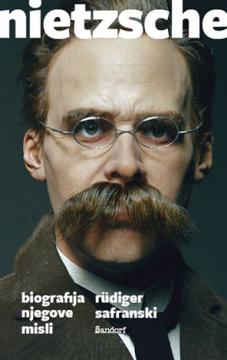
Nietzsche: Biografija njegove misli

Nietzsche: Biografija njegove misli

Rüdiger Safranski

Rüdiger Safranski, known for his works on Schopenhauer, Heidegger, and Goethe, presents an intimate "biography of thought" of Friedrich Nietzsche. The study traces the evolution of his ideas through key events, contradictions, and creative crises.

Safranski, a German philosopher and biographer, debunks the myths surrounding Nietzsche’s work—from his sister’s manipulation of his inheritance to Nazi abuses—and shows Nietzsche as an “artist of thought” who lived his ideas, carrying the burden of the “immeasurable” like Atlas.

The book is divided into three stages of development:

  • Early Stage: Tragedy and Wagner’s Influence (1860s–1870s). A young philologist, obsessed with Wagner and Greek culture, Nietzsche writes The Birth of Tragedy (1872), revealing a Dionysian-Apollinian dualism: the chaos of passion and the order of form. Music is the key—Wagner’s opera “pleases him immeasurably,” but the breakup in 1876 marks a turning point. Nietzsche, sick and lonely, sees art as a salvation from nihilism.
  • Middle Stage: The Critique of Morals and the Eternal Return (1878–1882). In "Human, All Too Human" (1878), "Dawn" (1881) and "Joyful Science" (1882) he becomes an aphorist, criticizing Christian morality as "slavish" and celebrating the freedom of the spirit. "Thus Spoke Zarathustra" (1883–1885) introduces the superman (Übermensch) as the creator of values ​​and the eternal return: "To live so that you want life to be repeated forever". The will to power becomes the central idea: not the tyranny of morality over life, but the affirmation of life through the overcoming of all values.
  • Final phase: Critique of culture and collapse (1886–1900). In "Beyond Good and Evil" (1886), "Twilight of the Idols" (1889) and "Antichrist" (1888) Nietzsche destroys idols: "God is dead", and European culture is decadent. The Will to Power (posthumously) synthesizes all these ideas, but Nietzsche suffered a mental breakdown in 1889, spending the last decade of his life in silence. Safranski emphasizes Nietzsche's tragic nature: ecstasy, pathos, and illness shaped his thought.

Safranski concludes with a balance of reception – from existentialists (Kierkegaard's influence) to postmodernists (Foucault) – emphasizing Nietzsche's relevance: a fight against nihilism, an encouragement to self-overcoming, and a warning about the dangers of the "last man." The book is lucid, didactic, written with a gentle irony, ideal for those who want to understand why Nietzsche is the "most widely read philosopher": his imagination makes him an eternal challenge.

Titel des Originals
Nietzsche: Biographie seines Denkens
Übersetzung
Ines Meštrović
Editor
Darko Milošić
Maße
23 x 17 cm
Seitenzahl
335
Verlag
Sandorf, Zagreb, 2021.
 
Latein Schrift. Fester Einband mit Schutzumschlag.
Sprache: Kroatisch.
ISBN
978-9-53351-353-9

Angeboten wird ein Exemplar

Zustand:Ungebraucht
Zum Warenkorb hinzugefügt!
 

Interessieren Sie sich für ein anderes Buch? Sie können das Angebot über unsere Suchmaschine suchen und finden oder Bücher nach Kategorien durchsuchen.

Diese Titel könnten Sie auch interessieren

William Wordsworth: A Biography - The Early Years 1770-1803

William Wordsworth: A Biography - The Early Years 1770-1803

Mary Moorman

U svom predgovoru gospođa Moorman skromno tvrdi da nije saznala "mnoge nove činjenice o Wordsworthu", ali svakako obogaćuje nacrt njegovih ranih godina.

Oxford University Press, 1968.
Englisch. Latein Schrift. Taschenbuch.
11,46
Lucas Cranach. Le vieux.

Lucas Cranach. Le vieux.

Pierre Descargues
Aimery Somogy, 1959.
Französisch. Latein Schrift. Fester Einband mit Schutzumschlag.
14,98
Život i priključenija

Život i priključenija

Dositej Obradović
Školska knjiga, 1974.
Kroatisch. Latein Schrift. Taschenbuch.
6,46 - 6,48
Tragične kraljice

Tragične kraljice

Juliette Benzoni

The book is a collection of biographical stories, focused on the fates of 18 historical queens and empresses who are marked by beauty, ambition, love and tragic ends.

Alfa, 1981.
Kroatisch. Latein Schrift. Fester Einband mit Schutzumschlag.
4,82
Vitez Kristov dr. Ivan Merz

Vitez Kristov dr. Ivan Merz

Josip Vrbanek

The biography of Blessed Ivan Merz was written by his spiritual leader and confessor Father Josip Vrbanek, a Jesuit, who accompanied Blessed Ivan on his ascent to holiness in the last period of his life, from 1922 until his death in 1928.

Veliko križarsko bratstvo i veliko križarsko sestrinstvo, 1943.
Kroatisch. Latein Schrift. Taschenbuch.
19,56
Knjiga o Jovi Čarugi i Joci Udmaniću

Knjiga o Jovi Čarugi i Joci Udmaniću

Marino Zurl

A famous work by publicist Marin Zurlo that explores the lives of two legendary hajduks – Jovo Stanisavljević Čaruga and Joco Udmanić – who rampaged through Slavonia and Dalmatia in the 1920s, becoming symbols of resistance against injustice.

August Cesarec, 1972.
Kroatisch. Latein Schrift. Taschenbuch.
7,82