Teorija zajedničkog zločinačkog pothvata i međunarodno kazneno pravo-izazovi i kontroverze

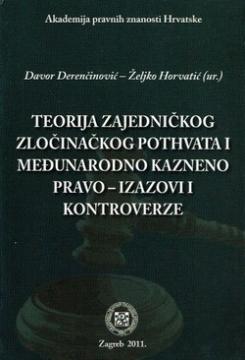
Teorija zajedničkog zločinačkog pothvata i međunarodno kazneno pravo-izazovi i kontroverze

Igor Bojanić, Davor Derenčinović, Željko Horvatić, Davor Krapac, Maja Seršić

Joint Criminal Enterprise (JCE) is a legal doctrine used during war crimes trials to allow group members to be prosecuted for group acts.

  1. The joint criminal enterprise was not part of customary international law at the time when the criminal acts charged against the defendants were committed.

  2. Joint criminal enterprise is contrary to the principle of guilt as one of the basic principles of modern criminal law.

  3. By dangerously expanding the elements of responsibility, a joint criminal enterprise is quite close to guilt by association, which is not provided for by the Statute of the ICTY.

  4. Deriving a conclusion about the existence of the defendant's intention from objective circumstances (inference) in the second and third category of joint criminal enterprise is questionable from the aspect of respecting the principle of the presumption of innocence of the defendant, which, among other things, is prescribed by Article 21/3 of the Statute of the ICTY.

  5. The judicial practice of the ICTY regarding the application of the theory of joint criminal enterprise and the provisions of the Statute in which this theory is allegedly contained is not unique and contradicts the principles of legal certainty and fairness.

  6. The widespread application of the theory of joint criminal enterprise to the entire political and military structures of the state and other "known and unknown" persons does not meet the requirement of a precise accusation and may create the impression of "political influence" on international criminal justice.

  7. Broadly conceived indictments based on the theory of joint criminal enterprise, which contain "collective" accusations not only of persons against whom criminal proceedings have been initiated, but of entire state and military structures as well as "known and unknown persons" threaten the foundations and operation of the ICTY.

  8. Giving credibility to the theory of joint criminal enterprise in proceedings before international criminal courts creates the risk of an even more widespread and more intrusive application of this theory in proceedings before national courts. The application of this theory undermines modern criminal law based on traditional principles and legal dogmatics.

  9. Widespread application of the theory of joint criminal enterprise will have negative consequences on the process of affirmation of international criminal law and justice.

  10. In the practice of international criminal tribunals, the theory of joint criminal enterprise should be replaced by other well-established institutes of personal criminal responsibility, such as complicity and indirect guilt.

Editor
Davor Derenčinović, Željko Horvatić
Titelseite
Andrej Kalšan
Maße
24 x 16,5 cm
Seitenzahl
253
Verlag
Akademija pravnih znanosti, Zagreb, 2011.
 
Latein Schrift. Taschenbuch.
Sprache: Kroatisch.
ISBN
978-9-53569-180-8

Angeboten wird ein Exemplar

Zustand:Gebraucht, in ausgezeichnetem Zustand
Zum Warenkorb hinzugefügt!
 

Interessieren Sie sich für ein anderes Buch? Sie können das Angebot über unsere Suchmaschine suchen und finden oder Bücher nach Kategorien durchsuchen.

Diese Titel könnten Sie auch interessieren

Hrvatski ljetopis za kazneno pravo i praksu / god.16 - br.2, str. 425-1022 (2009)

Hrvatski ljetopis za kazneno pravo i praksu / god.16 - br.2, str. 425-1022 (2009)

"Croatian Yearbook for Criminal Law and Practice" is a Croatian scientific and professional journal that publishes works in the field of criminal law theory and practice.

Hrvatsko udruženje za kaznene znanosti i praksu, 2009.
Kroatisch. Latein Schrift. Taschenbuch.
5,52
Problemi kaznene politike

Problemi kaznene politike

Dragomir Davidović, Milan Milutinović, Milan Simićević, Vladan Vasilijević, Sreten Veličković, Du...

Knjiga „Problemi krivične politike sudova“ iz 1973. godine sadrži materijale sa savetovanja održanog na Zlatiboru od 7. do 9. juna 1973. godine.

Institut za kriminološka i sociološka istraživanja, 1973.
Serbisch. Latein Schrift. Taschenbuch.
6,98
Hrvatski ljetopis za kazneno pravo i praksu / god. 18 - br.1, str. 1-308 (2011)

Hrvatski ljetopis za kazneno pravo i praksu / god. 18 - br.1, str. 1-308 (2011)

„Hrvatski godišnjak za kazneno pravo i praksu“ je hrvatski naučni i stručni časopis koji objavljuje radove iz oblasti krivičnopravne teorije i prakse.

Hrvatsko udruženje za kaznene znanosti i praksu, 2011.
Kroatisch. Latein Schrift. Taschenbuch.
5,52
Zakon o osnovnim vlasničkopravnim odnosima: komentar, sudska praksa i drugi odgovarajući propisi

Zakon o osnovnim vlasničkopravnim odnosima: komentar, sudska praksa i drugi odgovarajući propisi

Mladen Žuvela

Knjiga Zakon o osnovnim svojinskim odnosima, koju je priredio M. Žuvela, predstavlja klasičan komentar Zakona o osnovnim svojinskim odnosima (ZOVO) iz 1980. godine (Službeni list SFRJ, br. 6/80), sa 88 članova.

Narodne novine, 1990.
Kroatisch. Latein Schrift. Hardcover.
24,4822,03
Zbirka zakona kaznenog prava Republike Hrvatske: redakcijski pročišćeni tekstovi

Zbirka zakona kaznenog prava Republike Hrvatske: redakcijski pročišćeni tekstovi

Informator, 1996.
Kroatisch. Latein Schrift. Taschenbuch.
7,86