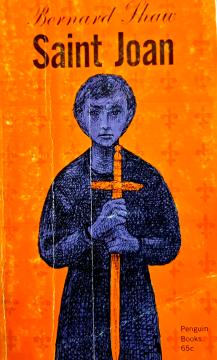
Sain Joan
Saint Joan (1923) is a celebrated historical drama by George Bernard Shaw about Joan of Arc, her rise, her trial for heresy, and the conflict between individual conscience and institutions of power.
The play Saint Joan, which premiered in 1923 and was published in 1924, is considered one of the greatest dramatic achievements of the Irish-British Nobel laureate George Bernard Shaw. Based on historical records from the trial of Joan of Arc, the play follows her journey—from a humble village girl who hears the voices of saints and leads the French army during the Hundred Years' War, to her capture, the inquisition trial, and her execution by burning at the stake in Rouen in 1431—concluding with a famous epilogue set after her canonization. Unlike romanticized portrayals that depict her solely as an innocent victim of malevolent judges, Shaw frames her tragedy as a profound clash of historical forces: Joan is presented as an exceptionally intelligent, courageous, and pragmatic young woman whose direct relationship with God and sense of national consciousness threaten the very foundations of the medieval Church and the feudal order. At the same time, her judges are not portrayed as mere villains, but as steadfast defenders of institutional authority, convinced that they are protecting the established order from chaos. Through a blend of sharp dialectics, historical irony, and tragic grandeur, Shaw created a modern dramatic classic about the price of visionary thinking and an unyielding conscience.
Angeboten wird ein Exemplar