Henryk Sienkiewicz
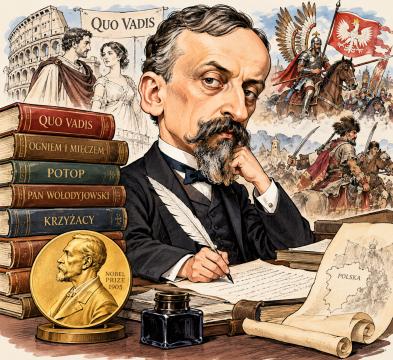
Henryk Adam Aleksander Pius Sienkiewicz (Wola Okrzejska, May 5, 1846 – Vevey, Switzerland, November 15, 1916) was a Polish writer, journalist, and recipient of the 1905 Nobel Prize in Literature, as well as one of the most prominent figures of Polish realism. He studied in Warsaw and began his literary career by writing newspaper articles, feuilletons, and short stories. His travels throughout Europe, the United States, and Africa enriched his literary style and the thematic scope of his work.
Sienkiewicz achieved literary fame through his historical novels, which weave together national history, adventure, romance, and moral values. His most renowned work, Quo Vadis (1896)—set during the reign of the Roman Emperor Nero—depicts the persecution of the early Christians and the clash between the pagan world and Christian ideals. The novel has been translated into numerous languages and adapted for the screen many times.
A significant place in his body of work is held by his historical trilogy—With Fire and Sword (Ogniem i mieczem, 1884), The Deluge (Potop, 1886), and Pan Wołodyjowski (1888)—which focuses on the turbulent history of the Polish-Lithuanian Commonwealth during the 17th century. Also significant are the novels Without Dogma (Bez dogmatu, 1891), The Połaniecki Family (Rodzina Połanieckich, 1895), and The Knights of the Teutonic Order (Krzyżacy, 1900), as well as the adventure novel for young readers, In Desert and Wilderness (W pustyni i w puszczy, 1911).
His short stories—notably The Lighthouse Keeper (Latarnik), Janko the Musician (Janko Muzykant), and Sachem—address social injustice, poverty, and the fate of the individual.
Sienkiewicz was a prominent advocate for Polish national identity during a period when Poland did not exist as an independent state. During the First World War, he participated in organizing humanitarian aid for the Polish population. He died in Switzerland, and his remains were transferred to Warsaw in 1924. His literary legacy is characterized by epic scope, narrative skill, patriotism, and universal humanistic values.
Titles in our offer
Potop
Die Sintflut, eines der bedeutendsten Werke der polnischen und weltgeschichtlichen Literatur, schildert auf epische Weise die dramatische Zeit der schwedischen Sintflut in der polnisch-litauischen Union in den Jahren 1655–1660.

Potop II
„Die Sintflut“ ist ein historischer Roman, der im 17. Jahrhundert während des schwedisch-polnischen Krieges spielt.
Quo vadis?
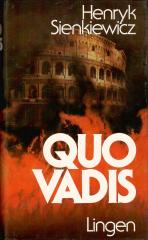
Der Roman Quo Vadis schildert die Liebe zwischen dem römischen Patrizier Marcus Vinicius und der Christin Lygia während der Herrschaft Kaiser Neros sowie den Konflikt zwischen der Grausamkeit des Römischen Reiches und christlichen Werten.
Quo vadis?
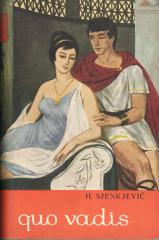
The novel Quo Vadis is a historical saga set in Rome during the reign of Emperor Nero. Written with epochal breadth, the work explores the conflict between early Christianity and decadent Roman society, with a love story at its center.
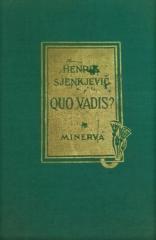
Quo Vadis?
The novel Quo Vadis is a historical saga set in Rome during the reign of Emperor Nero. Written with epochal breadth, the work explores the conflict between early Christianity and decadent Roman society, with a love story at its center.
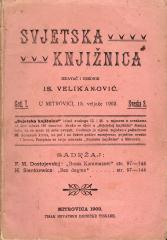
Svjetska knjižnica, Sv. 3.
The World Library, Volume 3, edited and published by Iso Velikanović, contains excerpts from The Brothers Karamazov by F. M. Dostoevsky and Without Dogma by H. Sienkiewicz. Designed for self-binding of individual works.
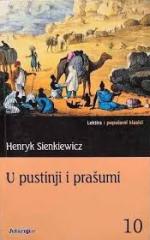
U pustinji i prašumi
Staś Tarkowski and little Nel Rawlinson are kidnapped during the Mahdi's rebellion in Africa. The children flee through the Sahara Desert and the rainforest, facing danger, hunger, and wild animals.