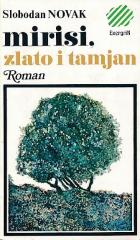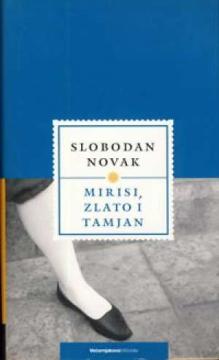
Fragrances, gold and incense is a novel rich in meanings. It intertwines life and legend, mythical and real, atheism and hypertrophied religiosity.
It is a book about disappointment in the world and people, about nausea and disgust, about a man who has lost the meaning of life, about lost illusions. The borderline existential situation of the main character is marked by anxiety, precisely Sartre's metaphor of disgust, getting closer to oneself and moving away from oneself, hopeless Godot waiting: Mali is waiting for "the life that could come when a death that does not come" comes. For him, living means "constantly choosing the harsher alternative". This feverish dialogue with one's own conscience, full of disturbing moralism, is the pinnacle of Croatian existentialist prose.
Editor
Branka Primorac, Seid Serdarević
Illustrationen
Stanko Abadžić
Titelseite
Vanja Cuculić
Maße
21 x 12,5 cm
Seitenzahl
235
Verlag
Večernji list, Zagreb, 2004.
Latein Schrift. Fester Einband mit Schutzumschlag.
Interessieren Sie sich für ein anderes Buch? Sie können das Angebot über unsere Suchmaschine suchen und finden oder Bücher nach Kategorien durchsuchen.
Diese Titel könnten Sie auch interessieren
Croatian literature • Literary criticism • Literary Theory
A novel by Croatian writer Slobodan Novak, written in 1967 and published in 1968. It is one of the most highly regarded novels in Croatian literature in general. It is often cited as an example of existentialist literature. It is told through the monologu
Znanje, 1985.
Kroatisch. Latein Schrift. Taschenbuch.
6,32 €
Historical novel • A war novel • Novel • Serbian literature
Deobe is a novel about the tragic division of Serbs into Chetniks and Partisans during World War II. Winner of the NIN Award, it is part of a wider epic trilogy, inspired by Ćosić's experiences and historical documents.
Prosveta, 1963.
Kroatisch. Latein Schrift. Fester Einband mit Schutzumschlag.
Branislav Glumac published a novel without periods or commas in 1974, as the relentless stream of thought of a young rebel. Published in socialist Yugoslavia, the work caused a scandal with its openness and became a classic about generational rebellion.
The work is based on a true event that occurred in Spain in 1933: Aurora Rodriguez killed her daughter Hildegart, a famous fighter for women's emancipation and a cult figure on the political scene of the time.
Mladost, 1990.
Kroatisch. Latein Schrift. Fester Einband mit Schutzumschlag.