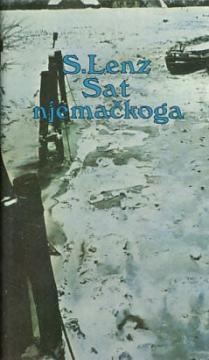
Sat njemačkoga

Sat njemačkoga

Siegfried Lenz

The German Hour (1968) by Siegfried Lenz is a German novel that deals with themes of duty, obedience, and moral responsibility in the context of Nazi Germany, told through the perspective of the young Sigi Jensen.

The story unfolds in two time periods: the 1950s, as Sigi writes an essay in a reformatory, and the 1940s, through memories of his life in the village of Rugbüll.

Sigi, the son of policeman Jens Ole Jensen, recalls his father's obsessive obedience to the Nazi regime. Jens, tasked with enforcing a painting ban on the artist Max Ludwig Nansen, who has been labeled a "degenerate", becomes increasingly obsessed with his duty, despite having once been a friend of the artist. Max, inspired by the North Sea landscape, continues to paint despite the ban, which causes conflict with Jens. Sigi, torn between admiration for the artist and loyalty to his father, witnesses how fanaticism destroys family and personal relationships. His rebellion against his father's blind obedience leads him into conflict with the authorities, culminating in his imprisonment.

The novel, written in the form of Sigi's essay, examines how authority and obedience stifle individuality and morality. Through rich descriptions and psychological depth, Lenz creates a powerful critique of Nazism and conformism, while the North Sea landscape symbolizes freedom and resistance. The work is a universal story of the conflict between conscience and duty, with a message about the importance of personal integrity.

Original title
Deutschstundf
Translation
Leo Držić
Editor
Milan Mirić
Graphics design
Alfred Pal
Dimensions
21 x 12.5 cm
Pages
425
Publisher
Sveučilišna naklada Liber (SNL), Zagreb, 1979.
 
Latin alphabet. Hardcover with dust jacket.
Language: Croatian.

One copy is available

Condition:Used, excellent condition
 

Are you interested in another book? You can search the offer using our search engine or browse books by category.

You may also be interested in these titles

Crni Napoleon

Crni Napoleon

Karl Otten

The Black Napoleon (1931) is a fictional biography of Toussaint Louverture. It depicts the Haitian Revolution (1791–1803), the slave uprising in Saint-Domingue, Louverture's brilliant military and political rise, and his struggle against the colonial powe

Nakladni zavod Ante Velzek, 1940.
Croatian. Latin alphabet. Hardcover with dust jacket.
6.32 - 14.56
Sanjaj nemogući san

Sanjaj nemogući san

Johannes Mario Simmel

From the bestselling author of "Jimmy and the Rainbow," comes a novel that weaves a love story with the stirring events of the Bosnian war. This story, woven into the historical context, reminds us that sometimes the impossible dream is the only one worth

Mozaik knjiga, 1997.
Croatian. Latin alphabet. Hardcover.
7.42
Iskra života

Iskra života

Erich Maria Remarque

Spark of Life follows a group of inmates in a Nazi concentration camp who, despite the constant terror, retain their moral strength and humanity. The novel depicts the struggle of the spirit against systematic destruction and the need for hope.

Džepna knjiga, 1955.
Serbian. Latin alphabet. Paperback.
3.00 - 3.24
Joseph Fouché: Roman jednoga političara

Joseph Fouché: Roman jednoga političara

Stefan Zweig

Joseph Fouché (1930) is a brilliant biography of a brilliant and unscrupulous opportunist – a Minister of Police who served all regimes: the Revolution, Napoleon and the Bourbons, becoming a symbol of political cunning and moral emptiness.

Naklada Binoza, 1935.
Croatian. Latin alphabet. Hardcover with dust jacket.
8.62
Felix Austria: antologija austrijske kratke priče

Felix Austria: antologija austrijske kratke priče

Milka Car

The book presents a selection of short stories by about 15 Austrian authors, trying to show the development of Austrian short prose - from realism and naturalism through modernity and expressionism to post-war and postmodernist literature.

Naklada MD, 2003.
Croatian. Latin alphabet. Paperback.
12.38
Kaiserove kulije: roman njemačke ratne mornarice

Kaiserove kulije: roman njemačke ratne mornarice

Theodor Plievier

The Kaiser's Coolies (1930) is an anti-militarist novel by Theodor Plievier. Based on his own experience, it depicts the brutal life of ordinary sailors in the German navy during World War I and the sailors' mutiny of 1917.

Naklada Binoza, 1934.
Croatian. Latin alphabet. Hardcover with dust jacket.
5.263.68