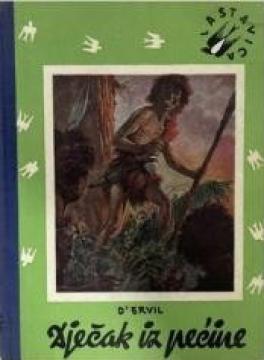
Dječak iz pećine

Dječak iz pećine

Ernest D'hervilly

The boy Krek keeps a fire in his cave, but carelessly extinguishes it. Exiled from his tribe, he goes through a series of dangerous adventures in prehistoric France, matures and proves his worth.

The Boy in the Cave (1888) is an adventure story for young people by Ernest d’Hervilly, considered his most successful work. The story is set in the Late Paleolithic, approximately 25,000 years ago, in what is now France.

The main character is a nine-year-old boy Krek, a smart and brave boy from a tribe of cavemen (Cro-Magnons). The tribe entrusts him with the most precious thing – guarding the fire in the cave hearth while the adults go hunting. Krek, however, plays and the fire goes out. In prehistoric times, this is a serious crime because fire means warmth, protection from wild beasts, cooking food and the survival of the entire tribe. As punishment, the boy is exiled from the community.

Alone in the harsh nature, Krek faces numerous dangers: hunger, cold, wild animals (mammoths, rhinoceroses, cave lions), conflicts with other tribes and his own fear. Traveling through forests, plains, and caves, he learns to make stone tools, hunt, navigate nature, and survive. He meets friendly characters, including an old man who helps him, and even members of other groups (e.g., the lake people).

The novel simultaneously depicts the growth and maturation of the main character. Through difficult trials, Krek becomes stronger, wiser, and more responsible. The author emphasizes the importance of community – in the end, the tribe forgives Krek's transgression, and he returns as a useful member of society.

D'Hervilly wrote the story under the influence of contemporary discoveries in archaeology and Darwin's theory of evolution. Although some details are scientifically outdated today (e.g., the depiction of the Cro-Magnons), the book comes alive thanks to vivid descriptions of nature, animals, and the daily lives of prehistoric people. The style is dynamic, adventurous, and instructive, with an emphasis on courage, ingenuity, and human solidarity.

The Boy from the Cave is a pioneering work in the genre of prehistoric literature for children. In its Croatian translation, it was popular reading, stimulating imagination and interest in the distant past of humanity.

Original title
Aventures d’un petit garçon préhistorique en France
Translation
Živojin Vukadinović
Editor
Ahmet Hromadžić
Illustrations
Željko Marjanović
Graphics design
Željko Marjanović
Dimensions
20 x 14 cm
Pages
115
Publisher
Narodna prosvjeta, Sarajevo, 1959.
 
Latin alphabet. Hardcover.
Language: Croatian.

One copy is available

Condition:Used, excellent condition
Damages or inconvenience notice:
  • Traces of patina
 

Are you interested in another book? You can search the offer using our search engine or browse books by category.

You may also be interested in these titles

Kleopatra: Egipatska kraljica

Kleopatra: Egipatska kraljica

Claude Ferval

The novel tells the lavish story of the last Egyptian queen, a woman of exceptional intelligence and beauty, whose life, love affairs with Caesar and Antony, and tragic death symbolize the collision of power, passion, and fate.

Alfa, 1985.
Croatian. Latin alphabet. Hardcover with dust jacket.
8.34
Megre i sumnjičavi supružnici / Megre i mali ministrant

Megre i sumnjičavi supružnici / Megre i mali ministrant

Georges Simenon

Maigret uncovers the truth in a marriage where suspicion and fear have blurred the line between reality and imagination.

Rad, 1969.
Serbian. Latin alphabet. Paperback.
5.00
Most na reci Kvaj / Dželat

Most na reci Kvaj / Dželat

Pierre Boulle

The Bridge on the River Kwai (1952) is a famous story about British prisoners who, under pressure from the Japanese, build a bridge in the jungle. The Executioner (1954) is a philosophical novella about a Chinese executioner who becomes a victim of his ow

Minerva, 1960.
Serbian. Latin alphabet. Hardcover.
4.26
Megre pred porotom / Megre i malerozni inspektor

Megre pred porotom / Megre i malerozni inspektor

Georges Simenon

In both novels, Maigret, through investigations and court proceedings, uncovers the hidden motives and psychology of the characters, showing that behind crimes there are always complex human stories.

Rad, 1969.
Serbian. Latin alphabet. Paperback.
4.88
Émile Zola

Émile Zola

Žerminal

In his best work, Germinal, Émile Zola realistically, in minute detail, described the inhuman living and working conditions of miners in northern France in the 1860s.

Svjetlost, 1967.
Serbian. Latin alphabet. Hardcover.
4.50
Rastavljena

Rastavljena

Pierre Mauriac

A spiritual novel about a woman who is separating from her husband, dealing with the consequences of divorce, and searching for meaning through faith, suffering, and a Christian understanding of marriage and family.

Hrvatsko književno društvo Sv. Jeronima, 1933.
Croatian. Latin alphabet. Hardcover.
8.26