Turistička destinacija

Turistička destinacija

Rui Zink

A tourist destination deals with the question of the destination, the question of where we are going, as well as the idea of ​​tourists. A tourist is someone who doesn't know how things will unfold in the future, who is just visiting, just passing through

Rui Zink is in fashion. That is the inevitable truth. He started with the television show Night of Evil Languages, continued writing chronicles for the daily newspaper Independente... and then an experimental theater group from the University of Aveiro, delighted by Zink's stories Reality now in color, made a theater play based on that book.

In the daily newspaper Visao, March 7, 1996.

Rui Zink is a storyteller who plunges into the chaos and absurdity of everyday life, a sharp satirist, a master of irony - irony that sometimes backfires on the author himself - and a skilled craftsman of the Portuguese language. His works reflect the complexity of literature and life, the meaninglessness of institutions and their hypocrisy, the anxiety of the moment, love and sex, family and memory, the blindness of the media, the carefree ignorance of many people and, not least, the constant presence of death, which usually arrives in a stupid and funny way.

From a review by Helena Vasconcelos, 2005.

In one of these tourist programs - seven days of half-board in a country ravaged by war, where the beaches are mined and full of shells, where kidnappings of tourists are a daily occurrence - the protagonist of these pages, Servajit Duvla, to the readers Greg (tourist pseudonym), or according to the local taxi driver, Gereg, due to difficulties in pronunciation, finds himself. We learn that, due to some mishaps related to his son's moral honor, Greg paid for that tourist destination for one reason only: he wants to die, to kill himself.

Pedro Neves, February 3, 2009.

Original title
O destino turistico
Translation
Tanja Tarbuk
Editor
Branko Čegec
Dimensions
19.5 x 11.5 cm
Pages
207
Publisher
MeandarMedia, Zagreb, 2011.
 
Latin alphabet. Paperback.
Language: Croatian.
ISBN
978-9-53735-589-0

One copy is available

Condition:Used, excellent condition
Specificity of this instance:
Dedication
 

Are you interested in another book? You can search the offer using our search engine or browse books by category.

You may also be interested in these titles

Doba života, doba smrti / Slavoluk pobjede / Ljubi bližnjega svoga

Doba života, doba smrti / Slavoluk pobjede / Ljubi bližnjega svoga

Erich Maria Remarque

Selected works of Remarque in three volumes.

SKD Prosvjeta, 1963.
Croatian. Latin alphabet. Hardcover.
The book consists of 3 volumes
9.56
Andrićeva lestvica užasa

Andrićeva lestvica užasa

Svetislav Basara

A Serbian writer known for his satirical novels, Andrić's Ladder of Horrors dissects the Balkan mentality through a parable of Yugo-nostalgia and national myths. The title alludes to Ivo Andrić as a litmus test for criticism – Balkans claim him or reject

24 sata, 2021.
Serbian. Latin alphabet. Paperback.
11.56
Stotina godina (antikronika)

Stotina godina (antikronika)

Dario Harjaček

The novel One Hundred Years by Dario Harjaček provides a panoramic view of Trešnjevka and its inhabitants through a century of changes, ideologies, and human destinies – a mosaic of Zagreb in which life, art, and history intertwine.

Oceanmore, 2025.
Croatian. Latin alphabet. Paperback.
13.42
Magična ljubavna kutijica

Magična ljubavna kutijica

Santa Montefiore

The Magic Love Box (2002) follows the life story of Federica Campione, which begins in Vina del Mar, Chile, in the summer of 1982. Montefiore creates an epic story of growth, where the magic is not only in the box, but in the courage to let go of the past

Mozaik knjiga, 2006.
Croatian. Latin alphabet. Hardcover.
7.34
Neprijatelji / ljubavna priča

Neprijatelji / ljubavna priča

Isaac Bashevis Singer

Enemies: A Love Story, perhaps Singer's best-known novel, takes place in New York in the 1950s.

Svjetlost, 1986.
Croatian. Latin alphabet. Hardcover with dust jacket.
5.98
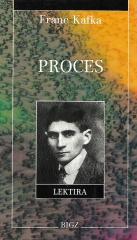
Proces

Proces

Franz Kafka

Kafka wrote The Process between 1914 and 1915, published posthumously in 1925. The novel is unfinished but with an added final chapter by Max Brod. Edition with a foreword by B. Živojinović and an afterword by Walter Killi.

BIGZ, 1990.
Serbian. Latin alphabet. Paperback.
4.26