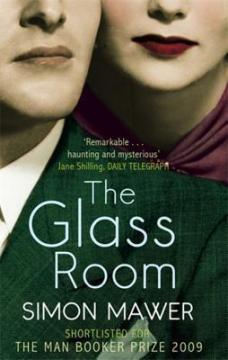
The Glass Room

The Glass Room

Simon Mawer

Brimming with barely contained passion and cruelty, the precision of science, the wild variance of lust, the catharsis of confession, and the fear of failure - the Glass Room contains it all.

Honeymooners Viktor and Liesel Landauer are filled with the optimism and cultural vibrancy of central Europe of the 1920s when they meet modernist architect Rainer von Abt. He builds for them a home to embody their exuberant faith in the future, and the Landauer House becomes an instant masterpiece. Viktor and Liesel, a rich Jewish mogul married to a thoughtful, modern gentile, pour all of their hopes for their marriage and budding family into their stunning new home, filling it with children, friends, and a generation of artists and thinkers eager to abandon old-world European style in favor of the new and the avant-garde. But as life intervenes, their new home also brings out their most passionate desires and darkest secrets. As Viktor searches for a warmer, less challenging comfort in the arms of another woman, and Liesel turns to her wild, mischievous friend Hana for excitement, the marriage begins to show signs of strain. The radiant honesty and idealism of 1930 quickly evaporate beneath the storm clouds of World War II. As Nazi troops enter the country, the family must leave their old life behind and attempt to escape to America before Viktor's Jewish roots draw Nazi attention, and before the family itself dissolves.

As the Landauers struggle for survival abroad, their home slips from hand to hand, from Czech to Nazi to Soviet possession and finally back to the Czechoslovak state, with new inhabitants always falling under the fervent and unrelenting influence of the Glass Room. Its crystalline perfection exerts a gravitational pull on those who know it, inspiring them, freeing them, calling them back, until the Landauers themselves are finally drawn home to where their story began.

Dimensions
20 x 13 cm
Pages
406
Publisher
Abacus, London, 2009.
 
Latin alphabet. Paperback.
Language: English.
ISBN
978-0-34912-132-1

One copy is available

Condition:Used, excellent condition
 

Are you interested in another book? You can search the offer using our search engine or browse books by category.

You may also be interested in these titles

Aurorin poticaj

Aurorin poticaj

Erich Hackl

The work is based on a true event that occurred in Spain in 1933: Aurora Rodriguez killed her daughter Hildegart, a famous fighter for women's emancipation and a cult figure on the political scene of the time.

Mladost, 1990.
Croatian. Latin alphabet. Hardcover with dust jacket.
4.96 - 4.98
Crna kutija

Crna kutija

Amos Oz

The Black Box is a kaleidoscope of married life and love relationships. It is a novel that implicitly speaks about all of us.

Hena Com, 2001.
Croatian. Latin alphabet. Hardcover.
10.98
Kuća u kojoj stanuje vrag

Kuća u kojoj stanuje vrag

Goran Tribuson

In The House Where the Devil Dwells, Tribuson also thematizes the time of new poverty, crazy jokes on the way to earning money, usury, jealousy, revenge, strikes, and murders.

Znanje, 2006.
Croatian. Latin alphabet. Paperback.
7.875.90
V.

V.

Thomas Pynchon

The novel represents a journey into an alternative world – a world that we all belong to from time to time, but of which we would not want to be a part, a world of paranoia and alienation that we are not entirely sure is just an alternative or the bare tr

Čarobna knjiga, 2010.
Serbian. Latin alphabet. Paperback.
21.9819.78
Kvaka braka

Kvaka braka

Melanie Gideon

Melanie Gideon, an American writer known for her humorous novels about family dynamics, dissects the monotony of marriage in the age of social media in The Marriage Trap (2012).

Algoritam, 2013.
Croatian. Latin alphabet. Paperback.
7.36
Priča o karmi

Priča o karmi

B. D. Benedict

A Story of Karma is one of the most famous and best-selling novels by Božidar D. Benedikt, a pioneer of the “religious thriller.” The book is still considered Benedikt's most influential work – a cross between Dan Brown and Carlos Castaneda.

Stari grad, 1997.
Croatian. Latin alphabet. Hardcover.
15.2210.65 - 15.34