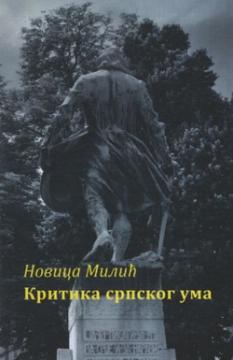
Kritika srpskog uma

Kritika srpskog uma

Novica Milić

The book's starting point is that the Serbs were not only caught up in the Enlightenment later than its European foray in the 18th century, but they resisted it even when it caught up with them. In the Balkans, history followed different paths, had differ

On the one hand, Milić analyzes the motives of Kant's criticism, showing that "criticism" in Kant means "justification", that is, under what conditions reason and mind are legitimately used. Illegitimate, for example, is the use of the mind that does not know its own limits, as in the Holocaust, for example, where the Nazis tried to justify the extermination of the Jews with (false) rational arguments. Where, therefore, the mind is unable to recognize and set limits for itself, to establish itself, where the mind does not recognize the laws (constitutions) that it has established for the benefit of the entire community, disaster inevitably follows. On the other hand, analyzing the history of Serbia, Milić shows what was happening in Serbia at a time when, in Europe, spears were breaking for the rule of reason (law), that is, when the ideas of enlightenment, despite all obstacles, stabilized. Milić's analysis of history, however, does not go in large waves, but focuses on important bearers of modern ideas (like Dositej Obradović or Božo Grujović), that is, on the fiercest opponents of modernization projects (like Nikolaj Velimirović), in order to show, in small steps, why Serbia never accepted the ideas of the Enlightenment, why it fell off the European track and remained on secondary historical paths. In other words, Serbia has never in its history been able to adopt criticism - in every sense of the term - nor to institutionalize it as a necessary prerequisite for a healthy common life.

Dimensions
19 x 12 cm
Pages
206
Publisher
Most art Jugoslavija, Beograd, 2023.
 
Cyrillic alphabet. Paperback.
Language: Serbian.

One copy is available

Condition:Used, excellent condition
 

Are you interested in another book? You can search the offer using our search engine or browse books by category.

You may also be interested in these titles

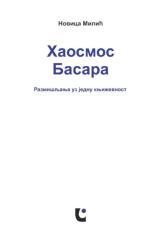
Haosmos Basara

Haosmos Basara

Novica Milić

Novica Milić gives Basara the status he deserves - he reads him as a relevant world writer. He "pulls" it out of the bilge of the palanquin and places it on the stage of world literature, where only one thing matters: what and how the writer does with wor

Factum izdavaštvo, 2020.
Serbian. Cyrillic alphabet. Paperback.
9.56
Nepouzdani svjedok

Nepouzdani svjedok

Nigel West
Alfa, 1988.
Croatian. Latin alphabet. Hardcover with dust jacket.
6.88
Nuclear Holocaust and Christian Hope

Nuclear Holocaust and Christian Hope

Ronald J. Sider, Richard K. Taylor
Inter Varsity Press, 1983.
Croatian. Latin alphabet. Paperback.
3.24
Sjećanja na saradnju s Alijom Izetbegovićem

Sjećanja na saradnju s Alijom Izetbegovićem

Nihad Halilbegović

Nihad Halilbegović's book is a memoir testimony of long-term professional and personal cooperation with Alija Izetbegović, the first president of independent Bosnia and Herzegovina.

Fond kantona Sarajevo, 2018.
Croatian. Latin alphabet. Hardcover.
9.98
Identitetske aporije

Identitetske aporije

Milorad Nikčević
Hrvatsko-crnogorsko društvo prijateljstva Croatica-Montenegrina, 2020.
Croatian. Latin alphabet. Paperback.
6.80
"Enigma" do pobjede

"Enigma" do pobjede

Ilija Marinković

The story of three Polish mathematicians who cracked the German Enigma cipher machine in the 1930s. Their secret work allowed the Allies to read Nazi messages during the war, shortening it by years and saving millions of lives.

NIŠRO "Vjesnik", 1977.
Croatian. Latin alphabet. Hardcover.
6.325.06