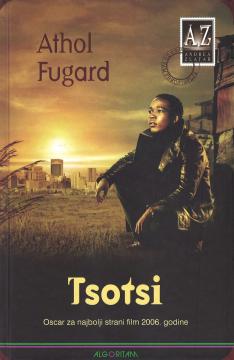
Tsotsi

Tsotsi

Athol Fugard

The novel Tsotsi is set in the slums of Johannesburg during apartheid and follows six days in the life of a young gangster known only as Tsotsi, which means "criminal" in Afrikaans.

Without a past or identity, Tsotsi leads a small gang of Boston, Butcher and Die Aap, surviving through violence and crime.

After his gang brutally murders a miner for pay, Boston, the only educated member of the group, questions Tsotsi's callousness. Tsotsi then brutally beats him up and kicks him out of the gang. Fleeing from his thoughts, Tsotsi impulsively hijacks a car, shooting the driver, and discovers a baby in the back seat. Unexpectedly, he decides to keep the child, which becomes a turning point in his life.

Unable to care for the baby, he forces the young mother, Miriam, to breastfeed it. Through interactions with her and an encounter with the disabled Morris, Tsotsi begins to question his actions and memories of his own childhood, which was marked by trauma and abandonment. Gradually, compassion and a desire for change emerge.

When he decides to return the baby to its parents, he is confronted by the police. Despite being threatened with a gun, he surrenders the child and calmly surrenders to the authorities, symbolizing his inner transformation and quest for redemption.

Fugard's novel explores themes of identity, violence, compassion, and the possibility of moral renewal, offering a powerful critique of social injustices in South Africa.

Translation
Damir Biličić
Editor
Andrea Zlatar
Graphics design
Nenad Martić
Dimensions
24 x 15.5 cm
Pages
190
Publisher
Algoritam, Zagreb, 2007.
 
Latin alphabet. Hardcover.
Language: Croatian.

One copy is available

Condition:Used, excellent condition
 

Are you interested in another book? You can search the offer using our search engine or browse books by category.

You may also be interested in these titles

Noć

Noć

Edgar Hilsenrath

A poignant novel describing life in a Jewish ghetto in Ukraine, based on the author's experience as a Holocaust survivor. Set in the fictional town of Prokov, the novel follows the inhabitants of the ghetto, especially Raneko, as they struggle to survive.

August Cesarec, 1982.
Croatian. Latin alphabet. Hardcover with dust jacket.
6.58
Brdo

Brdo

Ivica Prtenjača

It is a deeply disturbing text, full of emotions and traumatic experiences of a collapsed, imploded urban individual crying out for the meaning of life.

VBZ, 2014.
Croatian. Latin alphabet. Paperback.
7.82
Ljubičice u srijedu

Ljubičice u srijedu

Andre Maurois

André Maurois, a French writer known for his psychological novels and biographies, explores themes of family relationships, love, and internal conflicts in this work, which is characteristic of his style.

Svjetlost, 1965.
Croatian. Latin alphabet. Paperback.
3.42 - 3.62
Aurorin poticaj

Aurorin poticaj

Erich Hackl

The work is based on a true event that occurred in Spain in 1933: Aurora Rodriguez killed her daughter Hildegart, a famous fighter for women's emancipation and a cult figure on the political scene of the time.

Mladost, 1990.
Croatian. Latin alphabet. Hardcover with dust jacket.
4.96 - 4.98
Proces

Proces

Franz Kafka

Kafka wrote The Process between 1914 and 1915, published posthumously in 1925. The novel is unfinished but with an added final chapter by Max Brod. Edition with a foreword by B. Živojinović and an afterword by Walter Killi.

BIGZ, 1990.
Serbian. Latin alphabet. Paperback.
4.26
Tri mušketira 1-2

Tri mušketira 1-2

Alexandre Dumas

Dumas' version of the story depicts the adventures of d'Artagnan and his friends from 1625 to 1628.

Epoha, 1966.
Croatian. Latin alphabet. Hardcover with dust jacket.
The book consists of two volumes
9.48