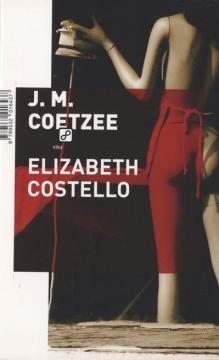
Elizabeth Costello

Elizabeth Costello

John Maxwell Coetzee

Elizabeth tirelessly lectures and gives speeches all over the world. Although it is not entirely clear in this work where fiction ends and fiction begins, the character of Elizabeth is a metaphor for a writer who does not write but gives formal speeches.

Following Elizabeth's life, Coetzee reveals to us her contradictions, her relationship with her son, her obsession with animal rights, her models of communication between people... Coetzee used the story of the writer to talk about the Holocaust, colonialism, Greek mythology, Christian morality, Kafka, the absurd - all the while weaving a contemplative and abstract web with real life. The climax of the novel comes when Elizabeth faces the loss of text, the loss of words, because she has nothing left to say. Writing a novel of big ideas, Coetzee seems to be re-problematizing the questions of what it means to be human, but also how to create meaning and give life its lost meaning.

Translation
Petar Vujačić
Editor
Nenad Rizvanović
Dimensions
24 x 16 cm
Pages
165
Publisher
VBZ, Zagreb, 2007.
 
Latin alphabet. Hardcover.
Language: Croatian.

One copy is available

Condition:Used, excellent condition
 

Are you interested in another book? You can search the offer using our search engine or browse books by category.

You may also be interested in these titles

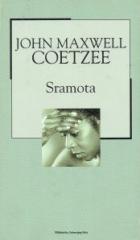
Sramota

Sramota

John Maxwell Coetzee

Shame is a novel by J. M. Coetzee, published in 1999. It won the Booker Prize. The author was awarded the Nobel Prize for Literature four years after its publication.

Globus, 2004.
Croatian. Latin alphabet. Hardcover with dust jacket.
2.96
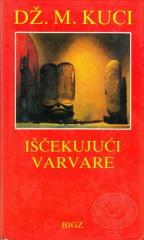
Iščekujući varvare

Iščekujući varvare

John Maxwell Coetzee
BIGZ, 1990.
Serbian. Latin alphabet. Hardcover with dust jacket.
9.99
Zagrepčanka

Zagrepčanka

Branislav Glumac

Branislav Glumac published a novel without periods or commas in 1974, as the relentless stream of thought of a young rebel. Published in socialist Yugoslavia, the work caused a scandal with its openness and became a classic about generational rebellion.

IROS, 1986.
Croatian. Latin alphabet. Hardcover.
8.24
Deobe 1-3

Deobe 1-3

Dobrica Ćosić

This work, awarded the NIN Prize for that year, is considered one of the most significant in Serbian literature after World War II.

Prosveta, 1961.
Serbian. Cyrillic alphabet. Hardcover with dust jacket.
The book consists of 3 volumes
11.42
Usta puna zemlje

Usta puna zemlje

Branimir Šćepanović

The novel "Usta puna zemlje" (1970), the masterpiece of the Serbian writer Branimir Šćepanović, is a psychologically in-depth explorer of the limits of the human soul, solitude and existential freedom, reminiscent of Kafka and Camus.

BIGZ, 1987.
Serbian. Latin alphabet. Paperback.
3.98
Proces

Proces

Franz Kafka

Kafka wrote The Process between 1914 and 1915, published posthumously in 1925. The novel is unfinished but with an added final chapter by Max Brod. Edition with a foreword by B. Živojinović and an afterword by Walter Killi.

BIGZ, 1990.
Serbian. Latin alphabet. Paperback.
4.26