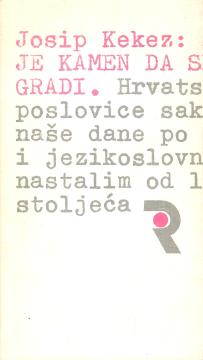
Svaki je kamen da se kuća gradi: Hrvatske poslovice sakupljene u naše dane po književnim i jezikoslovnim djelima nastalima od 12. do 19. stoljeća

Svaki je kamen da se kuća gradi: Hrvatske poslovice sakupljene u naše dane po književnim i jezikoslovnim djelima nastalima od 12. do 19. stoljeća

Josip Kekez

An anthological collection with comments by Josip Kekez, a Croatian folklorist and Slavist. A classic work of Croatian folkloristics from the 1980s.

Kekez systematically combed through Croatian literary and linguistic texts from the 12th century (Glagolitic monuments, Marko Marulić, Hanibal Lucić) to the 19th century (Renaissance writers, folk literature) and extracted the proverbs that appear in them.

The book is divided into two parts:

  • Theoretical-historical introduction – Kekez explains the genesis of proverbs, their role in literature (as stylistic decoration, wisdom, irony), the evolution from oral to written tradition and their significance for the Croatian language and culture.
  • Presentation of proverbs – proverbs arranged alphabetically or thematically with source references (author, work, year), context and short comments on meaning or variants.

The title "Every stone is a building block" symbolizes proverbs as "stone" building elements of Croatian culture – every little wisdom contributes to the larger "house" of language and identity.

The book is an important contribution to folkloristics and phraseology – it shows how proverbs lived in literature, and not only in oral tradition. It is valued as a reference for the study of Croatian paremiology (proverbs), with an emphasis on continuity from the Middle Ages to the Renaissance. Kekez later expanded the topic in "Proverbs, Riddles and Speech Forms" (1996).

Editor
Josip Cvenić
Dimensions
20.5 x 11.5 cm
Pages
153
Publisher
Izdavački centar Revija, Osijek, 1986.
 
Latin alphabet. Paperback.
Language: Croatian.

One copy is available

Condition:Used, excellent condition
 

Are you interested in another book? You can search the offer using our search engine or browse books by category.

You may also be interested in these titles

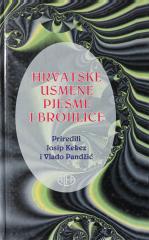
Hrvatske usmene pjesme i brojilice

Hrvatske usmene pjesme i brojilice

Josip Kekez, Vlado Pandžić
Alfa, 1996.
Croatian. Latin alphabet. Hardcover.
2.99
Dizanje prošlosti u vazduh: Ogledi o Balkanu i Istočnoj Evropi

Dizanje prošlosti u vazduh: Ogledi o Balkanu i Istočnoj Evropi

Marija Todorova

A collection of essays by the Bulgarian historian Maria Todorova (known for Imaginary Balkans), compiled especially for the 20th Century Library. Indispensable for understanding post-communist transitions, culture of memory and Balkan studies.

Biblioteka XX vek, 2010.
Serbian. Latin alphabet. Paperback.
8.44
Eseji i članci

Eseji i članci

Ljubo Karaman

The collection Essays and Articles by Ljubo Karaman, an eminent art historian, includes a series of texts on Croatian art, with an emphasis on the medieval heritage of Dalmatia and its connection with European cultural movements.

Matica hrvatska, 1939.
Croatian. Latin alphabet. Hardcover.
10.347.24
Istra i njeni razvojni putovi

Istra i njeni razvojni putovi

Juraj Pađen, Stanko Žuljić

The book Istria and its Development Paths from 1973, edited by Juraj Pađen and Stanko Žuljić, is a comprehensive analysis of the economic and social development of Istria in the context of the then Yugoslavia.

Ekonomski institut, 1973.
Croatian. Latin alphabet. Paperback.
7.50
Proizvodnja pokljuka u Požeškom Novom Selu: Separat

Proizvodnja pokljuka u Požeškom Novom Selu: Separat

Zdenka Lechner

Zdenka Lechner, the first ethnologist at the Museum of Slavonia (1951–1965), made significant contributions to the study of the traditional culture of Slavonia, including the use of pokljuc – earthen lids for baking bread and pastries on the hearth.

Muzej Slavonije, 1962.
Croatian. Latin alphabet. Paperback.
6.32