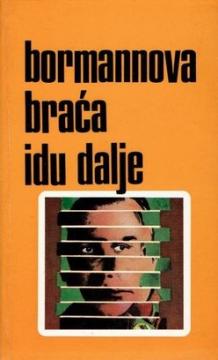
Bormannova braća idu dalje

Bormannova braća idu dalje

William Stevenson

The book reveals the secret network through which Martin Bormann, Hitler's treasurer, ensured the survival of Nazi power and capital after the fall of the Third Reich.

The Bormann Brothers Go On is an investigative story about the hidden continuation of the Nazi project after 1945. William Stevenson, a journalist and author known for his documentary approaches to real events, develops the thesis that Martin Bormann, a key figure in Hitler's inner circle and the financial manager of the Third Reich, prepared a large escape network during the war, known as the "Bormann Organization" or "Bormann Brotherhood".

According to the author, through a complex network of companies, banks and contacts around the world, Bormann ensured the escape of numerous high-ranking Nazis to South America, where they created new economic and political power under the auspices of industrial conglomerates. Stevenson argues that Nazi capital and connections continued to operate outside of Germany and influenced post-war geopolitics, the Cold War and international business circles.

The book combines elements of investigative journalism, historical reconstruction and spy fiction, often on the border between documented facts and controversial theories. Stevenson tries to show that Nazism did not end with the war, but transformed into a covert network of power operating behind the scenes of global politics and economics.

Original title
The Bormann Brotherhood
Translation
Vlasta Švarcmajer
Editor
Milan Osmak
Dimensions
20 x 12 cm
Pages
199
Publisher
NIŠRO "Vjesnik", Zagreb, 1977.
 
Latin alphabet. Hardcover.
Language: Croatian.

One copy is available

Condition:Used, excellent condition
 

Are you interested in another book? You can search the offer using our search engine or browse books by category.

You may also be interested in these titles

Zaraćeno poraće: Konfliktni i konkurentski narativi o stradanju i iseljavanju Talijana Istre

Zaraćeno poraće: Konfliktni i konkurentski narativi o stradanju i iseljavanju Talijana Istre

Franko Dota

The book analyzes how conflicting historical narratives about the suffering and mass emigration of Italians from Istria and Rijeka developed in Croatia and Italy after World War II (1943–1956), debunking myths and encouraging an empathetic approach to the

Srednja Europa, 2010.
Croatian. Latin alphabet. Paperback.
11.32
Školstvo u XX. stoljeću

Školstvo u XX. stoljeću

The collection "Education in the 20th Century", published in 2003 in Annals for the History of Education (vol. 2), contains papers from the professional-scientific meeting in Zagreb (October 25-27, 2001), held on the occasion of the 100th anniversary of t

Hrvatski školski muzej, 2003.
Croatian. Latin alphabet. Paperback.
5.984.49
Dizanje prošlosti u vazduh: Ogledi o Balkanu i Istočnoj Evropi

Dizanje prošlosti u vazduh: Ogledi o Balkanu i Istočnoj Evropi

Marija Todorova

A collection of essays by the Bulgarian historian Maria Todorova (known for Imaginary Balkans), compiled especially for the 20th Century Library. Indispensable for understanding post-communist transitions, culture of memory and Balkan studies.

Biblioteka XX vek, 2010.
Serbian. Latin alphabet. Paperback.
8.445.91
Snažan eho brionski: Odjeci Brionskog plenuma u Bosni i Hercegovini 1966. godine

Snažan eho brionski: Odjeci Brionskog plenuma u Bosni i Hercegovini 1966. godine

Amir Duranović

Amir Duranović's book reconstructs in detail the dramatic year 1966 and the Fourth (Brion) Session of the Central Committee of the Communist Party of Yugoslavia (July 1–2, 1966), at which Aleksandar Ranković, the long-time head of the UDB and vice preside

Udruženje za modernu historiju (UMHIS), 2017.
Croatian. Latin alphabet. Paperback.
9.547.15
Sudbonosni podvig Jugoslavije: Podsjećanje na historijsko NE staljinizmu, događaj koji je opredijelio budućnost Jugoslavije

Sudbonosni podvig Jugoslavije: Podsjećanje na historijsko NE staljinizmu, događaj koji je opredijelio budućnost Jugoslavije

Raif Dizdarević

The book by Raif Dizdarević, one of the last living actors of Yugoslav diplomacy, presents his reconstruction of the most fateful moment of post-war Yugoslavia – the split with Stalin and the Informburo in 1948–1953.

Udruženje za modernu historiju (UMHIS), 2018.
Croatian. Latin alphabet. Paperback.
23.58