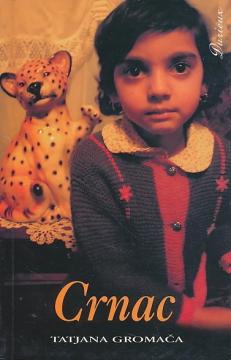
Crnac

Crnac

Tatjana Gromača

The novel The Black Man begins with the sentence “The house we lived in was wooden.” Wooden houses are reserved for fairy tales and stories for children.

The author does indeed write about childhood, a childhood that could be hers, but the narrator has no name, nor does the village she lives in, nor the city she goes to study in. The novel is composed of short fragments that sometimes read as short stories, sometimes as flashes of memory, and sometimes as prose poems. There are no elements of a fairy tale in the narrator's childhood, quite the opposite. In the suburbs of a provincial town known for its heavy industry, the child grows up surrounded by poverty, provincialism, and the subtle terror of people living empty lives. Going to study in a big city doesn't change anything either. The streets are bigger, a little better lit, but people with "empty gazes" still follow her. Gromača writes about the same Eastern European poverty described by Slavenka Drakulić, the same attitude towards women that Dubravka Ugrešić wrote about, but her prose fragments are closer to Danilo Kiš's novel The Garden, Ashes, Milan Kundera's The Joke, Agota Kristof's The Great Notebook, and Szymborska's poetry. Tatjana, like all good poets, knows how to say a lot with few words.

Editor
Nenad Popović
Dimensions
20 x 13 cm
Pages
159
Publisher
Durieux, Zagreb, 2004.
 
Latin alphabet. Paperback.
Language: Croatian.

One copy is available

Condition:Used, excellent condition
 

Are you interested in another book? You can search the offer using our search engine or browse books by category.

You may also be interested in these titles

Amandino vjenčanje

Amandino vjenčanje

Jenny Colgan

A romantic comedy about friendship, love, and the chaotic attempts to save a good man from a bad marriage. A chick-lit hit, it reminds us that friendship saves more than any plan, and love comes unexpectedly.

Znanje, 2001.
Croatian. Latin alphabet. Paperback.
5.36
Krčma

Krčma

Julian Stryjkowski

The book "Inn" by Julian Stryjkowski, published in 1977, explores life in a small Jewish village in Galicia during the 19th century.

BIGZ, 1977.
Serbian. Latin alphabet. Paperback.
4.38
Pariški maraton : Knjiga pisanja (Pariz21. i 22. oktobar 2023)

Pariški maraton : Knjiga pisanja (Pariz21. i 22. oktobar 2023)

At the end of the eighties, Damir Uzunović traveled to Paris and stayed there for less than a year. He was twenty years old at the time, and that exile episode would be formative for the literature he would later write.

Buybook, 2024.
Croatian. Latin alphabet. Hardcover.
12.22
Andrićeva lestvica užasa

Andrićeva lestvica užasa

Svetislav Basara

A Serbian writer known for his satirical novels, Andrić's Ladder of Horrors dissects the Balkan mentality through a parable of Yugo-nostalgia and national myths. The title alludes to Ivo Andrić as a litmus test for criticism – Balkans claim him or reject

24 sata, 2021.
Serbian. Latin alphabet. Paperback.
11.56
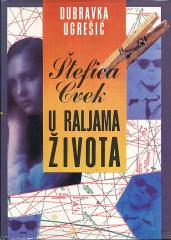
Štefica Cvek u raljama života

Štefica Cvek u raljama života

Dubravka Ugrešić

Do you like "lovelies"? Whatever you think about them, you'll enjoy this superb pastiche of trivial romance novels.

Mladinska knjiga, 1990.
Croatian. Latin alphabet. Hardcover with dust jacket.
4.94
Kreutzerova sonata, Hadži-Murat

Kreutzerova sonata, Hadži-Murat

Lav Nikolajevič Tolstoj

Kreutzer's sonata belongs to those works of Tolstoy that the writer adapted in many ways to his view on moral issues, on marital morality above all.

Civitas, 2004.
Croatian. Latin alphabet. Paperback.
4.98