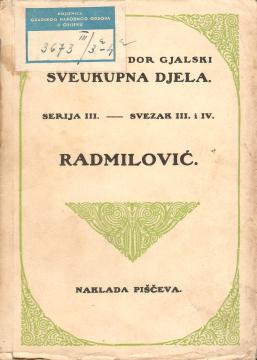
Radmilović
Radmilović (1913) is Gjalski's novel about the collision of ideals and reality: an intellectual full of high principles gets stuck in provincial politics, love and ambition, while the masks of decency slowly peel away.
Radmilović by Ksaver Šandor Gjalski is one of those novels that quietly draws you in, and you find yourself in the middle of a whirlpool in which idealism collides with muddy daily practice. At the center is Radmilović, an educated, principled and somewhat vain man who believes that a good argument can fix the world. When he enters local politics and the social networks of a small town, he realizes that the world does not change easily: behind polite smiles lie interests, behind big words small calculations, and between desire and duty an abyss gapes. Love Line tests him further: feelings require courage and consistency, while circumstances are favorable for silence.
Gjalski writes all this in his recognizable handwriting: elegant sentences, refined irony, psychological fine mechanics that work in the silence of salons and office corridors. The dramatic moments are not loud: they are brief glances, delays in speech, small betrayals that hurt more than big ones. The author accurately captures the provincial atmosphere — “what will people say” as a constant pressure — and shows how the idealist easily slips into compromise, and compromise into capitulation, if he does not have a solid point of support. At the same time, he leaves room for hope: dignity can be preserved, but the price is not small.
Who is the book for? For readers who love classics that think with their heads and hearts: a novel of ideas that is also a novel of character. If you enjoyed Under Old Roofs or In the Yellow House, Radmilović is a natural next step — serious, readable, and surprisingly contemporary in the questions it raises: how much are we willing to pay for our ideals and what remains of us when the stage lights go out?
One copy is available
- Slight damage to the cover