Žrtva lihvara
Antique
Rare book

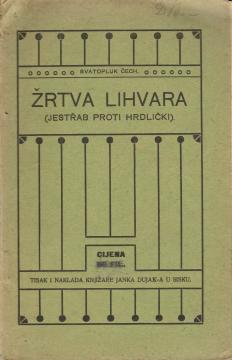
Žrtva lihvara

Svatopluk Čech

Svatopluk Čech's novella depicts the conflict between the peaceful, honest manager of Hrdlička and the ruthless usurer Jestřáb. The story is a harsh social critique of usury, exploitation, and the downfall of the common man under the pressure of monetary

Svatopluk Čech (1846–1908), one of the most important Czech writers of the second half of the 19th century, known for his social commitment and satire, wrote the novella The Victim of the Moneylender (1876).

The work is a sharp socially critical novel that shows the conflict between two opposite characters and two worlds. The main character is Hrdlička, a calm, honest and somewhat weak manager of the estate at the old manor castle. After the owner's death, he remains without protection and falls into debt slavery with the unscrupulous loan shark Jestřáb (Jestřáb = hawk). The usurer systematically exploits him, takes away his property, destroys family peace and forces him into complete ruin.

Čech masterfully contrasts Hrdlička's kindness, naivety and passivity with Jestřáb's cold calculation, greed and heartlessness. The novella is a strong criticism of usury as a social scourge, capitalist exploitation and the decline of the rural and petty bourgeoisie in the era of Austro-Hungarian capitalism. The writer shows how money and power destroy morality, family and human dignity.

The style is realistic with elements of satire and humor, typical of Čech. The work is relatively short, dynamic and readable, with a clear tendency - the defense of a small, honest man against predatory capital. In Czech literature, it is considered one of the early socially engaged prose works of Svatopluk Čech, who was otherwise better known for his epic poetry (Slávie, Lešetínský kovář).

In the Croatian context at the beginning of the 20th century, such editions (popular editions like Dujak's) were intended for a wider audience and served to spread social awareness and realism among readers. The book is an antiquarian rarity today.

Original title
Jestřáb contra Hrdlička
Translation
Pavao M. Rakoš
Dimensions
19.5 x 12.5 cm
Pages
104
Publisher
Tisak i naklada knjižare Janka Dujaka, Sisak, 1910.
 
Latin alphabet. Paperback.
Language: Croatian.

One copy is available

Condition:Used, excellent condition
Damages or inconvenience notice:
  • Slight damage to the cover
 

Are you interested in another book? You can search the offer using our search engine or browse books by category.

You may also be interested in these titles

Zlatno tele

Zlatno tele

Ilja Iljf, Jevgenij Petrov

The Golden Calf (1931) is a brilliant satirical picaresque adventure, a sequel to the legendary 12 Chairs, where the great schemer Ostap Bender returns in full glory – charming, cynical, irredeemably cunning and always one step ahead of everyone else.

Kultura, 1946.
Croatian. Latin alphabet. Hardcover with dust jacket.
7.56
Sasvim obične besmislice

Sasvim obične besmislice

Daniil Harms

Ignored and harassed by the authorities, surviving on the help of relatives and publishing children's rhymes, this ingenious marginal left behind a veritable treasure trove of strange stories and twisted thoughts in his notes and notebooks.

Šareni dućan, 1999.
Croatian. Latin alphabet. Paperback.
10.14
Zlatno telešce

Zlatno telešce

Ilja Iljf, Evgenij Petrov

The Golden Calf (1931) follows the ingenious con artist Ostap Bender, who in Soviet Russia during the first five-year plan seeks a secret millionaire in order to get rich, encountering the absurdity of bureaucracy, the new Soviet man, and his own downfall

Naklada Binoza, 1934.
Croatian. Latin alphabet. Hardcover with dust jacket.
9.74
Liga ribara

Liga ribara

Marija Andrijašević

The League of Fishermen brings together everything that makes us read Marija Andrijašević: complex characters, flexible and sumptuous language, convincing dialogues and stories that will hook you with discreet humor.

Oceanmore, 2024.
Croatian. Latin alphabet. Paperback.
11.98
Mjesec iznad Splita

Mjesec iznad Splita

Predrag Lucić

Predrag Lucić's second book of poetry, after "The Lovers from Verona" (2007), is a collection of irony, melancholy and contempt for canons - a dedication to the "ridicules" of Split, those who have woven their antics into the city's collective memory.

Algoritam, 2012.
Croatian. Latin alphabet. Paperback.
6.344.76
Gargantua i Pantagruel

Gargantua i Pantagruel

François Rabelais

Rabelais' masterpiece, a five-book novel cycle that follows the adventures of the giant Gargantua and his son Pantagruel. Vinaver, known for his linguistic virtuosity, masterfully conveys Rabelais's lavish humor, juicy swear words, and layered wordplay.

Kultura, 1950.
Serbian. Cyrillic alphabet. Hardcover.
The book consists of two volumes
11.34