Uput za sprečavanje i gašenje požara
Antique
Rare book

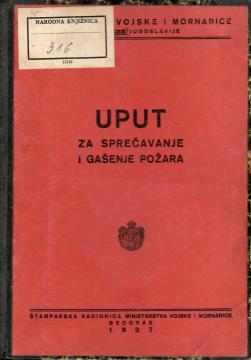
Uput za sprečavanje i gašenje požara

The Fire Prevention and Extinguishing Manual (1937) is an official manual intended for military units and institutions, with instructions for fire prevention, organization of protection, and extinguishing procedures in emergency situations.

The Fire Prevention and Extinguishing Manual, published in 1937, was a manual created as an official manual for military units, institutions and warehouses to reduce the risk of fire and ensure effective action in the event of a fire.

The publication provides basic fire protection rules, including the maintenance of facilities, proper handling of flammable materials, the organization of duty and supervision, and procedures for preventing fires. Special attention is paid to military warehouses, workshops, kitchens and other areas where there was an increased risk of fire.

The manual also describes the available extinguishing agents, how to use them and the organization of interventions. It emphasizes the importance of discipline, personnel training and rapid response in order to reduce material damage and protect human lives.

The book contains about thirty pages of illustrations in the appendix. Today, this edition is an interesting historical document that testifies to the development of fire protection and safety regulations in the military system of the Kingdom of Yugoslavia immediately before World War II.

Dimensions
20 x 14 cm
Pages
60
Publisher
Štamparska radionica Ministarstva vojske i mornarice Kraljevine Jugoslavije, Beograd, 1937.
 
Latin alphabet. Paperback.
Language: Serbian.

One copy is available

Condition:Used, excellent condition
Specificity of this instance:
Bound
 

Are you interested in another book? You can search the offer using our search engine or browse books by category.

You may also be interested in these titles

Živojin Pavlović: Između dogme i kritike

Živojin Pavlović: Između dogme i kritike

Slobodan Gavrilović

In terms of the number and content of facts, systematics, and method of interpretation, Gavrilović's work surpasses ordinary historiographical reading and stands side by side with the best literary creations about the events of one time and their actors.

Grafocard, 2001.
Serbian. Cyrillic alphabet. Paperback.
9.58
Omladinski pokret Jugoslavije

Omladinski pokret Jugoslavije

The book has a scientific-documentary character and is often used as a source in the study of political history and social movements in the former Yugoslavia.

Mladost, 1969.
Serbian. Latin alphabet. Hardcover with dust jacket.
9.98
Blago na putevima Jugoslavije: Enciklopedijsko-turistički vodič

Blago na putevima Jugoslavije: Enciklopedijsko-turistički vodič

A comprehensive encyclopedic guide to the cultural and natural heritage of the SFRY. Created in the spirit of Yugoslav tourism in the 1980s, the book serves as a practical tool for travelers, offering not only routes and descriptions, but also in-depth in

Jugoslavijapublik, 1983.
Croatian. Latin alphabet. Hardcover with dust jacket.
17.5613.17
Sam protiv njih

Sam protiv njih

Roman Leljak

A non-fiction work by a Slovenian investigator of the UDB archives. The author, a former KOS employee, left the army after learning about the crimes of the Yugoslav army during the war and the post-war period, and dedicated himself to exposing the secret

Vlastita naklada, 1990.
Croatian. Latin alphabet. Paperback.
16.42
Jovanka - žena koja je previša znala

Jovanka - žena koja je previša znala

Anamarija Mlačak

And what kind of husband was Tito? Man? The first Croatian biography of Comrade Jovanka answers that question, which was really of great interest to about 20 million Yugoslavs.

24 sata, 2013.
Croatian. Latin alphabet. Paperback.
6.98
Zaraćeno poraće: Konfliktni i konkurentski narativi o stradanju i iseljavanju Talijana Istre

Zaraćeno poraće: Konfliktni i konkurentski narativi o stradanju i iseljavanju Talijana Istre

Franko Dota

The book analyzes how conflicting historical narratives about the suffering and mass emigration of Italians from Istria and Rijeka developed in Croatia and Italy after World War II (1943–1956), debunking myths and encouraging an empathetic approach to the

Srednja Europa, 2010.
Croatian. Latin alphabet. Paperback.
11.32