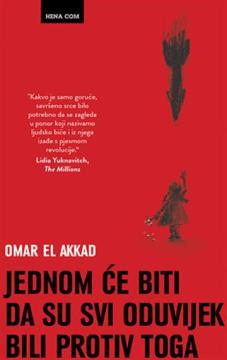
Jednom će biti da su svi oduvijek bili protiv toga

Jednom će biti da su svi oduvijek bili protiv toga

Omar el Akkad

A poignant nonfiction book in which the award-winning novelist and journalist sharply criticizes Western indifference to the war in Gaza, hypocrisy, and the limits of compassion in the modern world.

Someday It Will Be That Everyone Was Always Against It is a powerful non-fiction book by Canadian-Egyptian writer and journalist Omar El Akkad. The book is a personal, lucid, and furious manifesto about the war in Gaza, Western hypocrisy, and the limits of human compassion. El Akkad, who reported from war zones as a journalist, writes from the perspective of a father and an immigrant who once believed in Western ideals of justice and humanity. He now witnesses those ideals collapsing in the face of mass civilian suffering, especially children.

In a style that combines essayism, memoir, and sharp political criticism, the author dissects the mechanisms of media propaganda, political hypocrisy, and social indifference. The book simultaneously explores what it means to be a father in a world of violence and how to raise a child while the world actively participates in the destruction of other children.

This is one of the most provocative and discussed non-fiction books of 2025 — a bold, uncomfortable, and unavoidable reflection on the moral state of the West in the 21st century. Ideal for readers seeking a deep, personal, and uncompromising confrontation with current global conflicts.

Original title
One Day, Everyone Will Have Always Been Against This
Translation
Srđan Dvornik, Hana Dvornik
Editor
Nermina Husković
Graphics design
Jasna Goreta
Dimensions
21.5 x 14 cm
Pages
216
Publisher
Hena Com, Zagreb, 2025.
 
Latin alphabet. Hardcover with dust jacket.
Language: Croatian.

One copy is available

Condition:Unused
 

Are you interested in another book? You can search the offer using our search engine or browse books by category.

You may also be interested in these titles

Historijska čitanka 2

Historijska čitanka 2

Miljenko Jergović

The first edition of the second part of the series with 5 new (bonus) stories by a famous writer and journalist. "This book completes the 'Historical Reader', a project - a column started on the pages of the Sarajevo magazine Dani, shortly after the end o

Durieux, 2004.
Croatian. Latin alphabet. Hardcover.
7.32
Imenik lijepih vještina I-II

Imenik lijepih vještina I-II

Miljenko Jergović

In The Directory of Fine Arts, Miljenko Jergović explores diverse topics, from literature to history, celebrating art and excellence. His essays offer deep understanding, imbued with intellectual passion and a love of the written word.

24 sata, 2018.
Croatian. Latin alphabet. Hardcover with dust jacket.
The book consists of two volumes
34.56
I drugi su pjevali o ratu: Odjeci raspada Jugoslavije u engleskoj i američkoj književnosti

I drugi su pjevali o ratu: Odjeci raspada Jugoslavije u engleskoj i američkoj književnosti

Muharem Bazdulj

In this book of essays, Muharem Bazdulj analyzes how the collapse of Yugoslavia and the wars of the 1990s resonated in Anglo-Saxon literature – from pre-war stereotypes to war and post-war depictions.

Biblioteka XX vek, 2013.
Croatian. Latin alphabet. Paperback.
8.24
Sizifova sreća - razgovori, kronike

Sizifova sreća - razgovori, kronike

Ivan Lovrenović

Ivan Lovrenović's collection documents thirty years of change in Bosnia and Herzegovina through interviews, essays, and dialogues. The author, a witness to the era, examines old attitudes in the new reality, emphasizing the atrophy of rationality and soci

Synopsis, 2018.
Croatian. Latin alphabet. Paperback.
12.54
Stari i novi razgovori s Krležom

Stari i novi razgovori s Krležom

Predrag Matvejević

These talks, started sometime in 1968, often stopped at considering the very form of this kind of talk.

Spektar, 1982.
Croatian. Latin alphabet. Hardcover.
11.24
Poezija i zbilja

Poezija i zbilja

Johann Wolfgang Goethe

Goethe's greatest autobiographical prose, written between 1811 and 1833, covers his life from his birth in 1749 in Frankfurt to 1775, when he went to Weimar at the invitation of Duke Karl August.

Matica hrvatska, 1953.
Croatian. Latin alphabet. Hardcover with dust jacket.
18.42