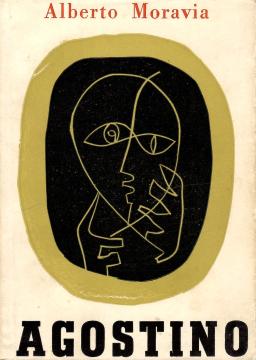
Agostino
Thirteen-year-old Agostino spends the summer at the seaside with his beautiful widowed mother. When she becomes close to her lover, the boy feels rejected and joins the company of rough local boys to get revenge and grow up.
Agostino is a short novella by Albert Moravia written in 1942 and published in 1944. Due to its bold themes, it was banned by fascist censors, but after its publication it became a great success and brought the author his first literary award.
The story takes place during a summer vacation on the Tuscan coast. Thirteen-year-old Agostino, a boy from a wealthy family, spends idyllic days with his widowed mother – they row together, swim and enjoy their closeness. His mother is an idealized figure for him: beautiful, dignified and completely devoted to him. But everything changes when she starts seeing the young, self-confident Renzo. Agostino suddenly feels neglected, jealous and betrayed. He begins to realize that his mother is not only a mother, but also a woman with her own desires and sexuality.
In search of solace and revenge, and wanting to prove his manhood, Agostino approaches a group of poor, rough local boys and their leader, the dubious savior Sara. These boys live in a completely different world – poor, raw and sexually experienced. Agostino is fascinated and disgusted at the same time. He is tolerated for his wealth, ridiculed for his innocence and ignorance of sex, and he masochistically submits to humiliations just to belong. Through these encounters, he quickly loses his childish innocence, confronts class differences, the rawness of life and his own awakening sexuality.
Moravia masterfully depicts the psychological storm of adolescence: a mixture of love, hatred, jealousy and guilt towards his mother, the desire to separate and the inability to escape from this relationship. The novel is rich in Freudian motifs (the Oedipus complex), but also social criticism – it contrasts bourgeois comfort and impoverished reality. It is written in a precise, dry style that heightens the tension and emotional rawness.
Agostino is a universal story of disillusionment and the painful entry into adulthood. It is considered one of Moravia's best works and a classic of Italian literature of the 20th century. There is also a film adaptation from 1962.
One copy is available