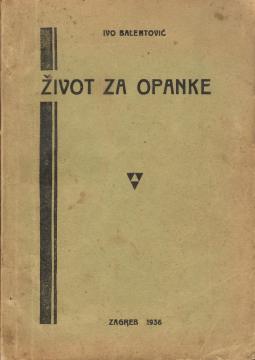
Život za opanke
The first literary work by Ivo Balentović, in which, through stories from Slavonian, Šokac rural life, he depicts the difficult fate of peasants, the penetration of capitalism into the countryside, emigration and the struggle for survival.
Life for Opanke is a collection of short stories that Ivo Balentović (1913–2001), born in Županjac, published in 1936 as his literary debut (self-published). This established him as one of the representatives of interwar Slavonian prose, alongside authors such as Josip Kozarac or Slavko Kolar. Balentović was only 23 years old at the time, and the collection immediately received positive reviews because it brought a fresh, authentic portrayal of life in Posavina.
The book consists of several short stories and short stories that draw material from rural Slavonia – from the Šokac villages along the Sava River. The title Life for Opanke is symbolic: the opanke represent traditional, poor peasant life, hard work on the land, attachment to tradition and the struggle for bare survival at a time when the village was beginning to experience profound changes under the influence of capitalism and modernization.
Balentović writes realistically, with a strong social commitment, but also with a lyrical, emotional tone. His characters are peasants, laborers, young people who go to America or the cities, women who carry the burden of their families, the elderly who preserve old customs. He describes poverty, hunger, injustice, conflicts between the old and the new, the exploitation of peasants by merchants and moneylenders, but also the warmth of family ties, Šokac weddings, customs and the beauty of the landscape along the Sava. The prose is sentimental-serial, with an emphasis on the psychology of the characters and social criticism.
This collection marks the beginning of Balentović's long literary journey. Later, he wrote about thirty more books - novels, collections of stories, poetry, travelogues, children's books and non-fiction. He lived in Županja, Zagreb, Istria (Umag), translated from Bulgarian and other languages, edited the newspaper Susreti and remained faithful to the themes of the Slavonian and Istrian regions.
Life for Opanka is today considered an important document of Croatian regional literature of the 20th century, a testimony to life in Posavina on the eve of World War II. The work is authentic, warm and nostalgic, and at the same time critically aware. The collection remains a witness to a disappearing world of Šokac villages and their “opanaks”.
One copy is available
- Yellowed pages