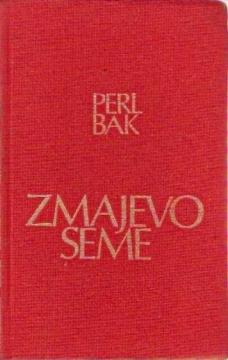
Sabrana dela 19: Zmajevo seme

Sabrana dela 19: Zmajevo seme

Pearl S. Buck

The family of Chinese peasant Ling Tan faces the Japanese invasion in 1937. The war destroys their lives, changes customs and inspires resistance. A moving story of the courage, suffering and struggle of the Chinese people.

The novel Dragon Seed by Pearl S. Buck is a powerful story about a Chinese peasant family living in a village near Nanjing just before and during the Japanese invasion of China in 1937. The book depicts the impact of the Second Sino-Japanese War on ordinary people, their lives, customs, and family relationships.

The central character is Ling Tan, a wise and stubborn peasant who loves his country, and his wife Ling Sao. They have three sons (Lao Ta, Lao Er, and Lao San), a daughter Panxiao, and a daughter-in-law. The family lives a relatively peaceful life, farming the land and adhering to traditional values, until the war reaches their village.

The Japanese army brings horrors: looting, rape, murder, and destruction. Some family members flee to the city, some become collaborators, and others join the guerrilla resistance. The novel realistically depicts how war changes people — traditional roles are broken down, women become more active, and young people become radicalized. The depiction of Nanking and the horrors that followed the fall of the city (the so-called Nanking Massacre) is particularly poignant, although Buck focuses on the characters' reactions, not just on the events themselves.

Buck masterfully depicts the contrast between peaceful peasant life and the brutality of war. The novel highlights themes of resistance, the courage of ordinary people, the clash of tradition and modern reality, and the deep connection of the Chinese with the land. Dragon Seed symbolizes the strength of the Chinese people who, like the dragon, will survive and revive.

The book is part of a trilogy (continued with the novels The Promise and others) and one of Buck's most famous works about the war period. It was written during World War II (1942) and had a great influence on American public opinion about Chinese resistance to Japan. It is characterized by vivid characters, realistic depiction of everyday life, and deep empathy for the Chinese people, which is characteristic of Buck's prose. It is often highlighted as a powerful anti-war novel that shows how war destroys families, but also awakens new strength and solidarity.

Original title
Dragon Seed
Translation
Nika Miličević
Editor
Voja Čolanović
Graphics design
Simon Ničev
Dimensions
20 x 12.5 cm
Pages
381
Publisher
Rad, Beograd, 1971.
 
Latin alphabet. Hardcover.
Language: Serbian.

Multiple copies are available

Copy number 1

Condition:Used, excellent condition

Copy number 2

Condition:Used, excellent condition

Copy number 3

Condition:Used, excellent condition
 

Are you interested in another book? You can search the offer using our search engine or browse books by category.

You may also be interested in these titles

Mati

Mati

Pearl S. Buck

A novel about a Chinese peasant woman who, after her husband leaves, raises her children alone, struggling with poverty, loneliness and social pressures, in a poignant story of motherhood and endurance.

Seljačka knjiga, 1952.
Croatian. Latin alphabet. Paperback.
7.99
Tvorac grada

Tvorac grada

Pearl S. Buck
Globus, 1986.
Serbian. Latin alphabet. Hardcover with dust jacket.
2.99
Sabrana dela 13: Ponosito srce

Sabrana dela 13: Ponosito srce

Pearl S. Buck

One of Pearl S. Buck's less frequently mentioned but very powerful novels (1938), which is quite different from her Chinese sagas. It is the story of a gifted, proud woman who struggles to remain both an artist and a woman, in a world that finds it diffic

Matica srpska, 1980.
Croatian. Latin alphabet. Paperback.
3.00
Baraka Pet Be i druge novele

Baraka Pet Be i druge novele

Miroslav Krleža

The collection "Baraka Pet Be i druge novele" brings a selection of Krleža's anti-war novels from the period 1916–1920s, focusing on the senselessness of World War I, the suffering of the Home Guard and the downfall of Austria-Hungary.

Mladost, 1987.
Croatian. Latin alphabet. Hardcover.
5.38
Vrijeme nasilja

Vrijeme nasilja

Jean-Pierre Simon

A Time of Violence (1966) is an anti-war and activist novel by French writer Jean-Pierre Simon, a lesser-known author from the mid-20th century, whose work bears traces of leftist literature of the 1930s and 1940s.

Svjetlost, 1965.
Croatian. Latin alphabet. Paperback.
2.46
Istok i Zapad

Istok i Zapad

Gerald Green

In East and West (1986), Green weaves an epic tale of love and war, intertwining the lives of ordinary people with great historical events. The novel is a powerful fresco of war, but also of an indestructible spirit seeking light amidst darkness.

August Cesarec, 1990.
Croatian. Latin alphabet. Paperback.
The book consists of two volumes
7.42