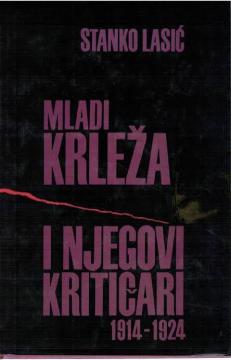
Mladi Krleža i njegovi kritičari (1914-1924)
Lasić's study uses the method of ontological structuralism to analyze Krleža's early oeuvre (1914–1924) and critical reactions, revealing the tension between aesthetic autonomy and ideological engagement.
Stanko Lasić's monograph Young Krleža and His Critics (1914-1924) is a key study of Croatian krležology that, by applying ontological structuralism, goes beyond the classical biographical and literary-historical frameworks. Lasić does not observe the early period of Krleža's work in isolation, but in an inseparable dynamic connection with the reception of his contemporaries, establishing the methodological foundation for his later monumental Krležology.
The work is conceived through four analytical layers: an immanent interpretation of the early opus (expressionist dramas, Legends, poetry and war prose), a typology of critical reactions, an analysis of the socio-historical context and a metacritical reckoning with the previous literature on Krleža. Lasić precisely classifies the echoes ranging from traditional bourgeois criticism – which sees "chaos" and a violation of the canon in Krleža's expression – to the avant-garde and early left, which try to reduce him to an ideological and propaganda tool.
The book's content is based on revealing the fundamental tension in the young Krleža: the conflict between the imperative of aesthetic autonomy and the Hegelian necessity of historical and political engagement. Through the analysis of the polemics and misunderstandings of contemporaries in the crucial period of the collapse of Austria-Hungary and the emergence of the Kingdom of Serbs, Croats, Croats and Slovenes, Lasić not only reconstructs the mental and aesthetic map of Croatian society, but also scientifically accurately depicts the process by which the disputed author imposed himself as the central figure of Croatian literature by 1924.
One copy is available