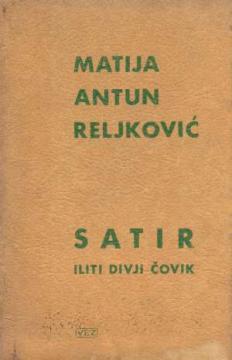
Satir iliti divlji čovik

Satir iliti divlji čovik

Matija Antun Reljković

The Enlightenment poem Satyr or the Wild Man by M. A. Reljković, through the dialogue between Satyr and Slavonian, sharply criticizes outdated customs and negligence and calls for education, work, and progress in Slavonia.

Satyr or the Wild Man (1st edition 1762, expanded in 1779) is the most important work of the Croatian Enlightenment, authored by the Slavonian writer and officer Matija Antun Reljković. Composed in the folk ten-line meter, this didactic-satirical poem was written with the clear intention of educating, instructing and economically uplifting the Slavonian peasantry after a century of Ottoman rule. The central part of the framework is the figure of Satyr – a mythical forest creature (“wild man”) – who observes Slavonia and, in a direct dialogue with a Slavonian peasant, offers a sharp criticism of the way of life of that time. Satyr does not spare the folk vices: superstition, drunkenness, idleness, neglect of agriculture, swearing and ignorance, labeling them the main culprits for the poverty and backwardness of the region. In contrast, Reljković glorifies the natural resources of Slavonia and offers specific Enlightenment advice on hygiene, rational economy, education and moral life. Although imbued with a Christian and moralistic spirit, the work had an extraordinary social and cultural impact. Satyr or Wild Man became extremely popular among contemporaries and remains a key testimony to the struggle for enlightenment and modernization of the Croatian countryside in the 18th century.

Editor
Ivo Bogner, Pavle Blažek
Graphics design
Predrag Gol
Dimensions
21 x 14 cm
Pages
159
Publisher
Glas Slavonije, Osijek, 1974.
 
Latin alphabet. Hardcover.
Language: Croatian.

Multiple copies are available

Copy number 1

Condition:Used, very good condition
Damages or inconvenience notice:
  • Slight damage to the cover

Copy number 2

Condition:Used, excellent condition

Copy number 3

Condition:Used, very good condition
Damages or inconvenience notice:
  • Worn covers
 

Are you interested in another book? You can search the offer using our search engine or browse books by category.

You may also be interested in these titles

U rovovima interpretacija: Strategija i tragedija nelegitimnog čitanja

U rovovima interpretacija: Strategija i tragedija nelegitimnog čitanja

Nebojša Lujanović

The book by Split writer and political scientist Nebojša Lujanović (born 1981 in Novi Travnik) is an intriguing polemic against the ideological abuses of Ivo Andrić, especially the nationalistic readings of his work from the Bosnian, Serbian and Croatian

V.B.Z, 2020.
Croatian. Latin alphabet. Hardcover.
13.4410.08
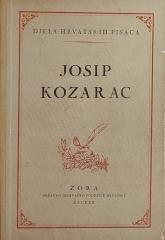
Djela hrvatskih pisaca: Josip Kozarac - Djela

Djela hrvatskih pisaca: Josip Kozarac - Djela

Josip Kozarac
Zora, 1950.
Croatian. Latin alphabet. Hardcover.
2.98
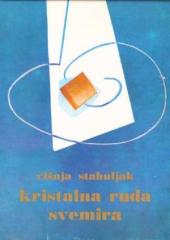
Kristalna ruda svemira

Kristalna ruda svemira

Višnja Stahuljak
Zrinski, 1978.
Croatian. Latin alphabet. Paperback.
2.50
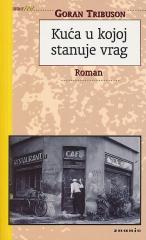
Kuća u kojoj stanuje vrag

Kuća u kojoj stanuje vrag

Goran Tribuson

In The House Where the Devil Dwells, Tribuson also thematizes the time of new poverty, crazy jokes on the way to earning money, usury, jealousy, revenge, strikes, and murders.

Znanje, 2006.
Croatian. Latin alphabet. Paperback.
7.87
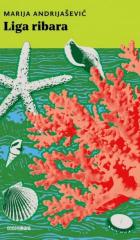
Liga ribara

Liga ribara

Marija Andrijašević

The League of Fishermen brings together everything that makes us read Marija Andrijašević: complex characters, flexible and sumptuous language, convincing dialogues and stories that will hook you with discreet humor.

Oceanmore, 2024.
Croatian. Latin alphabet. Paperback.
11.988.99
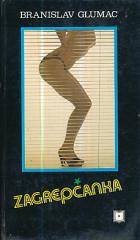
Zagrepčanka

Zagrepčanka

Branislav Glumac

Branislav Glumac published a novel without periods or commas in 1974, as the relentless stream of thought of a young rebel. Published in socialist Yugoslavia, the work caused a scandal with its openness and became a classic about generational rebellion.

IROS, 1986.
Croatian. Latin alphabet. Hardcover.
8.24