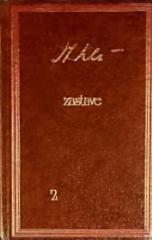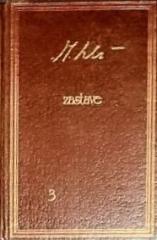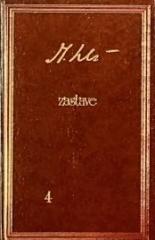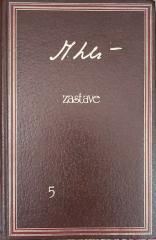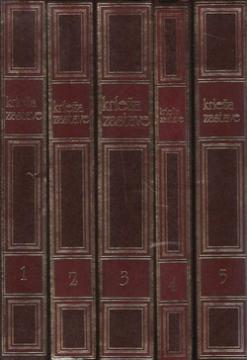
Zastave 1-5
Rare book

Zastave 1-5

Miroslav Krleža

Flags follows the turbulent period of Croatian history from 1912 to 1922 through the family showdown between the father and son of the Emerics, but the family story is only a basis for problematizing the Croatian, Serbian, Macedonian, and Albanian nationa

Miroslav Krleža's "Flags" are one of the most extensive and complex novels in Croatian literature. They were written between 1962 and 1968 and consist of five volumes in which the author depicts a dramatic period from the beginning of the 20th century – a time of the collapse of the Austro-Hungarian Monarchy, political turmoil, national conflicts and ideological fractures in Croatian society. At the center is the character of Franz/Franj Kamil Zvonić, a young man torn between loyalty to the empire and the search for a national, political and moral identity.

Through his inner struggle and path of spiritual maturation, Krleža paints the image of a typical intellectual of the era: an educated but disoriented man searching for meaning in a world full of contradictions. Zvonić's life and his relationships with other characters raise questions about belonging, faith, revolution, social injustice and personal responsibility. The novel encompasses a wide range of social classes – from the aristocracy and the military to workers and students – creating a panorama of a collapsing empire and the spiritual crisis of European man.

Krleža’s style in “Flags” is dense, rhythmic and layered, often shifting from narrative to philosophical discussion or lyrical meditation. The work builds on Krleža’s earlier themes – the relationship between the individual and ideology, intellectual self-awareness and moral dilemma. “Flags” is not only a political novel, but also a profound analysis of an era and its spirit. Krleža sees the collapse of the empire as a symbolic end to the illusions of order, religion and ideals that had shaped an entire generation.

Editor
Enes Čengić
Dimensions
20 x 13 cm
Pages total
1857
Publisher
Oslobođenje, Sarajevo, 1982.
 
Latin alphabet. Hardcover.
Language: Croatian.

The book consists of 5 volumes.

Dva višetomna primjerka su u ponudi.

Copy number 1
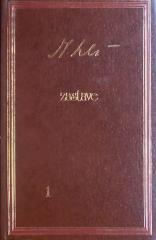
Zastave 1-5
Volume 1
Pages: 375
Condition:Used, excellent condition
Zastave 1-5
Volume 2
Pages: 368
Condition:Used, excellent condition
Zastave 1-5
Volume 3
Pages: 457
Condition:Used, excellent condition
Zastave 1-5
Volume 4
Pages: 272
Condition:Used, excellent condition
Zastave 1-5
Volume 5
Pages: 385
Condition:Used, excellent condition

Copy number 2

Zastave 1-5
Volume 1
Pages: 375
Condition:Unused
Zastave 1-5
Volume 2
Pages: 368
Condition:Unused
Zastave 1-5
Volume 3
Pages: 457
Condition:Unused
Zastave 1-5
Volume 4
Pages: 272
Condition:Unused
Zastave 1-5
Volume 5
Pages: 385
Condition:Unused

Two copies are available

Copy number 1

Zastave 1-5
Volume 1
Pages: 375
Condition:Used, excellent condition

Copy number 2

Zastave 1-5
Volume 2
Pages: 368
Condition:Used, excellent condition
 

Are you interested in another book? You can search the offer using our search engine or browse books by category.

You may also be interested in these titles

Na rubu pameti

Na rubu pameti

Miroslav Krleža

The novel "On the Edge of Reason" (1938) is Krleža's only novel in the first person. A doctor of law morally condemns a powerful industrialist at a banquet, thereby provoking a general social boycott, persecution, and his own downfall.

Jutarnji list, 2004.
Croatian. Latin alphabet. Hardcover with dust jacket.
5.26 - 5.62
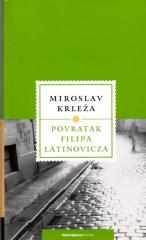
Povratak Filipa Latinovicza

Povratak Filipa Latinovicza

Miroslav Krleža

The Return of Filip Latinovicz is one of Miroslav Krleža's most famous novels. This novel is significant in our literature because it is considered the first fully modern Croatian novel.

Večernji list, 2004.
Croatian. Latin alphabet. Hardcover with dust jacket.
5.524.17 - 5.565.54
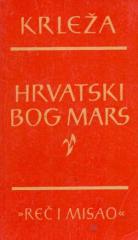
Hrvatski bog Mars

Hrvatski bog Mars

Miroslav Krleža

The Croatian god Mars brings seven anti-war novels in which Krleža portrays war as a cruel, senseless machinery that destroys the "little man", exposing the hypocrisy of militarism and myths about heroism.

Rad, 1965.
Serbian. Latin alphabet. Paperback.
1.99
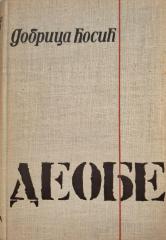
Deobe 1-3

Deobe 1-3

Dobrica Ćosić

This work, awarded the NIN Prize for that year, is considered one of the most significant in Serbian literature after World War II.

Prosveta, 1961.
Serbian. Cyrillic alphabet. Hardcover with dust jacket.
The book consists of 3 volumes
11.42
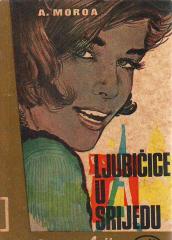
Ljubičice u srijedu

Ljubičice u srijedu

Andre Maurois

André Maurois, a French writer known for his psychological novels and biographies, explores themes of family relationships, love, and internal conflicts in this work, which is characteristic of his style.

Svjetlost, 1965.
Croatian. Latin alphabet. Paperback.
3.42 - 3.62
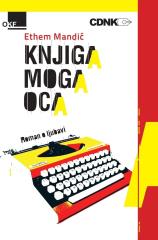
Knjiga moga oca

Knjiga moga oca

Ethem Mandić

This is a biography about my father made up of memories and mere imagination. History does not exist, and neither do facts. The past is unknown.

OKF d.o.o, 2016.
Croatian. Latin alphabet. Paperback.
10.648.51