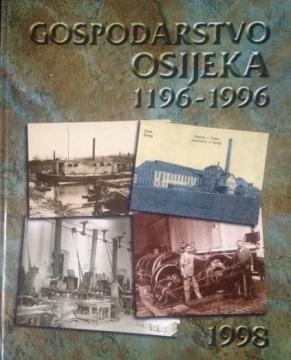
Gospodarstvo Osijeka 1196. – 1996.

Gospodarstvo Osijeka 1196. – 1996.

The book presents a comprehensive overview of the economic development of Osijek over eight centuries. The work is based on historical sources and scientific analyses, providing insight into economic conditions from the Middle Ages to the modern era.

The book begins with the earliest records of Osijek from 1196, describing its position as a trading and craft center on important traffic routes along the Danube. The author covers the periods under Hungarian, Ottoman and Habsburg rule in detail, emphasizing the importance of agriculture, trade and crafts. Special attention is paid to the 18th and 19th centuries, when Osijek became a significant economic center with the development of industry, especially textiles, food and metal. Đidara emphasizes the role of infrastructure, such as the construction of a railway and a port, in the modernization of the city.

In the 20th century, the book covers economic challenges during the world wars, the socialist period and the transition after Croatia gained independence. In particular, it analyzes industrial development in Yugoslavia and the impact of the 1991–1995 war on Osijek's economy. Đidara also discusses the potential for future development, including tourism and agriculture.

The book is structured chronologically, with an emphasis on empirical data, statistics and archival sources, making it a valuable resource for historians and economists. Although the focus is on Osijek, the work provides insight into the broader regional context of eastern Croatia. The style is academic, yet accessible, with the aim of preserving the historical memory of the city.

Editor
Slavko Singer
Graphics design
Mane Medić
Dimensions
24.5 x 20 cm
Pages
327
Publisher
Gradsko poglavarstvo grada Osijeka, Osijek, 1998.
 
Distribution: 1,000 copies
 
Latin alphabet. Hardcover.
Language: Croatian.

One copy is available

Condition:Used, excellent condition
 

Are you interested in another book? You can search the offer using our search engine or browse books by category.

You may also be interested in these titles

Komunizam i čovjek: Odnos vlasti i pojedinca u Hrvatskoj (1958.–1972.)

Komunizam i čovjek: Odnos vlasti i pojedinca u Hrvatskoj (1958.–1972.)

Josip Mihaljević

Josip Mihaljević's book analyzes the relationship between the government and the individual in communist Croatia (1958–1972), through repressive mechanisms, ideological pressures, and restrictions on personal freedom in the socialist system.

Hrvatski institut za povijest, 2016.
Croatian. Latin alphabet. Hardcover.
17.26
Pazin

Pazin

Petar Strčić

Pazin is a town in central Istria, known for its rich history and natural beauty. It is located above the karst abyss of Pazinska jama, into which the river Pazinčica plunges.

Skupština općine Pazin, 1982.
Croatian. Latin alphabet. Hardcover with dust jacket.
15.62
Osječka groblja

Osječka groblja

Stjepan Sršan

The book is deeply rooted in the local history and culture of Osijek, with an emphasis on cemetery motifs that serve as a metaphor for memory, death, and disappearance.

Povijesni arhiv u Osijeku, 1996.
Croatian. Latin alphabet. Paperback.
5.263.68
Hrvatska

Hrvatska

Antun Travirka

This book explores the cultural and historical heritage of Croatia.

Forum, 2015.
Croatian. Latin alphabet. Hardcover with dust jacket.
17.22
Gospodarska izvješća Iločkog vlastelinstva (1918.-1928.)

Gospodarska izvješća Iločkog vlastelinstva (1918.-1928.)

Stjepan Sršan

This book provides an insight into the economic aspects of the manor, its resources and activities during the mentioned decade.

Državni arhiv u Osijeku, 2006.
Croatian. Latin alphabet. Paperback.
8.98
Vojskovođa Svetozar Boroević 1856-1920.

Vojskovođa Svetozar Boroević 1856-1920.

Milan Pojić

Svetozar Boroević, the most capable Austro-Hungarian military leader of the First World War, the only Croat who received the title of field marshal and was awarded the highest Austrian decorations, has been systematically hushed up in Croatian history.

Hrvatski državni arhiv, 2006.
Croatian. Latin alphabet. Paperback.
5.46