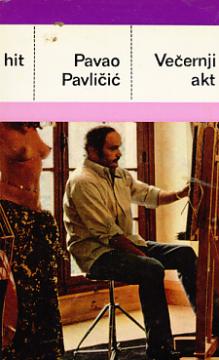
Večernji akt

Večernji akt

Pavao Pavličić

The story, centered on the brilliant forger Mihovil, criticizes the literature and art of our time. It also reflects on a society that is ready to adapt the coordinates of history to its own needs.

Mihovil, a student at the Academy of Fine Arts, lives with his grandmother on Medvedgradska Street and has an extraordinary ability to perfect forgeries – from banknotes and paintings to manuscripts and objects. His talent is revealed when he pays in a shop with a counterfeit banknote, which goes unnoticed, and his friend Zoran and the painter Kolarić recognize the genius of his copies, such as a perfect replica of Stančić’s painting. Mihovil’s skill attracts the attention of various circles – from artistic to criminal and political – which leads to a series of dramatic events. As the plot progresses, Mihovil’s forgeries become increasingly fantastic: he copies letters from Antun Gustav Matoš, plants, and even reality, creating alternative worlds, such as a fake Zagreb. His ability raises moral questions – does his forgery change reality or is it just a reflection of the relativity of truth? The authorities persecute him, considering him a threat, while he himself escapes persecution by transforming himself into the old man Bartol Mihetec. The novel culminates when Mihovil, in a new identity, begins writing a work that begins with the same sentence as "Evening Nude", hinting at cyclicality and self-referentiality.

Editor
Zlatko Crnković
Graphics design
Alfred Pal
Dimensions
19.5 x 12 cm
Pages
294
Publisher
Znanje, Zagreb, 1981.
 
Latin alphabet. Hardcover with dust jacket.
Language: Croatian.

One copy is available

Condition:Used, very good condition
Damages or inconvenience notice:
  • Slight damage to the dust jacket
 

Are you interested in another book? You can search the offer using our search engine or browse books by category.

You may also be interested in these titles

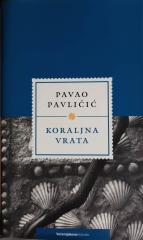
Koraljna vrata

Koraljna vrata

Pavao Pavličić

How to persuade high school students to read Gundulić's Osman? The question is difficult, but the answer is simple. So that they read Pavličić before Gundulić.

Večernji list, 2004.
Croatian. Latin alphabet. Hardcover with dust jacket.
3.26 - 4.78
Eter

Eter

Pavao Pavličić
Znanje, 1983.
Croatian. Latin alphabet. Hardcover.
4.99
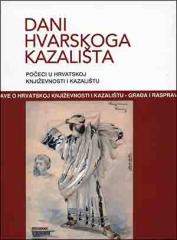
Dani hvarskog kazališta. Počeci u hrvatskoj književnosti i kazalištu

Dani hvarskog kazališta. Počeci u hrvatskoj književnosti i kazalištu

Maja Bošković Stuli, Dunja Fališevac, Milovan Tatarin, Lahorka Plejić Poje, Pavao Pavličić, Helen...
Hrvatska akademija znanosti i umjetnosti (HAZU), 2008.
Croatian. Latin alphabet. Paperback.
9.996.99
Štefica Cvek u raljama života

Štefica Cvek u raljama života

Dubravka Ugrešić

Do you like "lovelies"? Whatever you think about them, you'll enjoy this superb pastiche of trivial romance novels.

Mladinska knjiga, 1990.
Croatian. Latin alphabet. Hardcover with dust jacket.
4.94
Proces

Proces

Franz Kafka

Kafka wrote The Process between 1914 and 1915, published posthumously in 1925. The novel is unfinished but with an added final chapter by Max Brod. Edition with a foreword by B. Živojinović and an afterword by Walter Killi.

BIGZ, 1990.
Serbian. Latin alphabet. Paperback.
4.26
Usta puna zemlje

Usta puna zemlje

Branimir Šćepanović

The novel "Usta puna zemlje" (1970), the masterpiece of the Serbian writer Branimir Šćepanović, is a psychologically in-depth explorer of the limits of the human soul, solitude and existential freedom, reminiscent of Kafka and Camus.

BIGZ, 1987.
Serbian. Latin alphabet. Paperback.
3.98