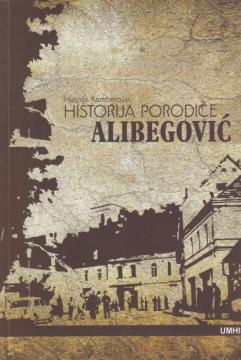
Historija porodice Alibegović: transformacija iz begovske zemljoposjedničke u modernu građansku porodicu

Historija porodice Alibegović: transformacija iz begovske zemljoposjedničke u modernu građansku porodicu

Husnija Kamberović

The book depicts the development of a Bosnian bey family that, throughout the 19th and 20th centuries, transformed from a landowning family into a modern bourgeois family, reflecting broader social changes in Bosnia and Herzegovina.

In the work History of the Alibegović Family: Transformation from a Bey Landowner to a Modern Bourgeois Family, historian Husnija Kamberović explores the centuries-long development of the distinguished Alibegović family, which originated from the Kobaška Captaincy. The book shows how social, economic and political circumstances in Bosnia and Herzegovina – from the Ottoman and Austro-Hungarian rule to the modern era – shaped the fate of the old Bey classes.

After the abolition of the captaincies, the Alibegovićs successfully transitioned from feudal to merchant class, developing new economic activities and adapting to changes that led many other noble families to ruin. The author analyzes their property, family networks and political activities, as well as relations with other important families such as the Gradaščevićs, the Pašićs and the Ibrahimpašićs through archival materials, correspondence and documents from the 19th century.

Kamberović’s work goes beyond a local study — it shows how the fate of the Alibegovićs is a mirror of the broader social transformation of the Bosnian Muslim elites. The book reflects the processes of modernization, national integration and cultural transition from the feudal to the civil era of Bosnia and Herzegovina.

Editor
Amir Duranović
Dimensions
24 x 17 cm
Pages
182
Publisher
Udruženje za modernu historiju (UMHIS), Sarajevo, 2021.
 
Latin alphabet. Paperback.
Language: Croatian.

One copy is available

Condition:Unused
 

Are you interested in another book? You can search the offer using our search engine or browse books by category.

You may also be interested in these titles

Titovi transkripti : zabranjena ljubav

Titovi transkripti : zabranjena ljubav

Alen Galović, Boris Rašeta

The book explores political relations in Yugoslavia, shows the internal dynamics of the government and offers an insight into the dilemmas and decisions of the time.

24 sata.
Croatian. Latin alphabet. Paperback.
4.78
I drugi su pjevali o ratu: Odjeci raspada Jugoslavije u engleskoj i američkoj književnosti

I drugi su pjevali o ratu: Odjeci raspada Jugoslavije u engleskoj i američkoj književnosti

Muharem Bazdulj

In this book of essays, Muharem Bazdulj analyzes how the collapse of Yugoslavia and the wars of the 1990s resonated in Anglo-Saxon literature – from pre-war stereotypes to war and post-war depictions.

Biblioteka XX vek, 2013.
Croatian. Latin alphabet. Paperback.
8.24
Umiruće tijelo politike: Rat - konstitucija nacionalnog tijela

Umiruće tijelo politike: Rat - konstitucija nacionalnog tijela

Senadin Musabegović

The philosophical and theoretical study by a Bosnian-Herzegovinian author analyzes how the war in Bosnia and Herzegovina from 1992 to 1995 was a biopolitical project of creating a "pure" national body through the systematic killing, expulsion, and rape of

Buybook, 2019.
Croatian. Latin alphabet. Paperback.
11.24
Put u Jajce

Put u Jajce

Edvard Kocbek

In Put u Jajce, Edvard Kocbek provides personal and political testimony about key moments in Yugoslav history. The book is based on Kocbek's memories from the Second World War, especially the trip to Jajce in 1943.

Znanje, 1978.
Croatian. Latin alphabet. Hardcover with dust jacket.
8.385.87
Knjiga o Titu

Knjiga o Titu

France Bevk

It is a work intended primarily for young people, written in a simple, accessible style, with the aim of creating a positive image of Tito as a revolutionary, statesman and leader of the national liberation struggle.

Svjetlost, 1987.
Croatian. Latin alphabet. Hardcover.
3.82
Omladinski pokret Jugoslavije

Omladinski pokret Jugoslavije

The book has a scientific-documentary character and is often used as a source in the study of political history and social movements in the former Yugoslavia.

Mladost, 1969.
Serbian. Latin alphabet. Hardcover with dust jacket.
9.986.99