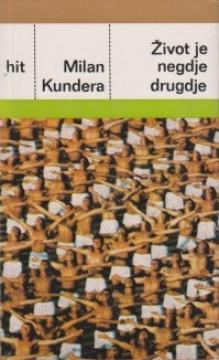
Život je negdje drugdje

Život je negdje drugdje

Milan Kundera

Jaromil, a young poet raised by a possessive mother, seeks a "real life" in poetry and revolution. His lyrical youth, love, and idealism lead him into conformity and betrayal of intimate relationships – he dies young and unfulfilled.

Life is Elsewhere is a satirical and philosophical novel by Milan Kundera, written in 1969, first published in French in 1973 (Kundera was already in exile at the time). The novel is a portrait of the artist as a young man – the lyric poet Jaromil, whose life is marked by his mother's obsessive love and his search for a "real life" that is always "somewhere else".

The plot spans from the 1930s to the early 1950s in Czechoslovakia: Jaromil's birth (his mother gives birth to him despite his father's request for an abortion), his childhood under his mother's influence (she sees him as a genius, sticks his verses on the wall), puberty with masturbation and fantasies about Xavier (an ideal alter ego), first loves (a red-haired saleswoman, a married woman) and finally his political involvement in the communist revolution of 1948–1949.

The mother (called Maman) is the central figure – possessive, romantic, lives through her son, rejects reality and drives Jaromil into a lyrical illusion. Jaromil, insecure and narcissistic, uses poetry as an escape from real life: he writes pathetic verses, dreams of revolution as an aesthetic act, but when the revolution wins, he becomes a conformist – betrays his friends, reports his mistress to the police out of jealousy and fear. His “lyrical age” (youth) is at once romantic and dangerous: lyricism merges with totalitarianism, poetry becomes propaganda.

The novel is divided into sections (the birth of the poet, Xavier, masturbation, mother, revolution, etc.), with Kundera’s typical ironic, essayistic digressions on art, love, politics and youth. The book criticizes romantic lyricism (Rimbaud, Shelley) which leads to political fanaticism – Jaromil is a caricature of a poet-revolutionary who sacrifices the intimate for the grandiose. There are no heroes: Jaromil is pathetic, the mother is pathetic, the revolution is fake.

The style is sharp, witty, erotic, with long philosophical passages – Kundera dissects youth as a "lyrical age" full of lies and self-deception. The novel is an early Kundera, part of the Czech cycle (along with The Joke, Funny Loves), but it announces later themes of alienation and false existence. In Croatian translation it remains one of Kundera's most appreciated novels – a bitter portrait of how idealism easily turns into cynicism and betrayal.

Original title
Život je jinde
Translation
Nikola Kršić
Editor
Zlatko Crnković
Graphics design
Alfred Pal
Dimensions
19 x 11 cm
Pages
265
Publisher
Znanje, Zagreb, 1979.
 
Latin alphabet. Hardcover with dust jacket.
Language: Croatian.

One copy is available

Condition:Used, good condition (visible signs of use)
Damages or inconvenience notice:
  • The cover is missing
  • Worn covers
 

Are you interested in another book? You can search the offer using our search engine or browse books by category.

You may also be interested in these titles

Spašeni jezik: Povijest jedne mladosti

Spašeni jezik: Povijest jedne mladosti

Elias Canetti

Autobiographical novel by Elias Canetti. The story begins when his young nanny secretly meets with the young man, which he sees as a child. The young man constantly threatened him that if he said anything to the adults, he would cut out his tongue.

Znanje, 1982.
Croatian. Latin alphabet. Hardcover with dust jacket.
8.76
Večernji akt

Večernji akt

Pavao Pavličić

The story, centered on the brilliant forger Mihovil, criticizes the literature and art of our time. It also reflects on a society that is ready to adapt the coordinates of history to its own needs.

Znanje, 1981.
Croatian. Latin alphabet. Hardcover with dust jacket.
3.98
Tijela i duhovi

Tijela i duhovi

Mirko Božić

Bodies and spirits is the third part of the Kurlan trilogy by Mirko Božić, published in 1981, which follows the novels Kurlani (1952) and Neisplakani (1955).

Znanje, 1981.
Croatian. Latin alphabet. Hardcover with dust jacket.
4.98
Konačna dijagnoza

Konačna dijagnoza

Arthur Hailey

Arthur Hailey's Final Diagnosis is a medical novel set in a large hospital. Through the fates of doctors and patients, it depicts responsibility, professional errors, and the conflict between tradition and progress in medicine.

Znanje, 1972.
Croatian. Latin alphabet. Hardcover with dust jacket.
4.42
Sva moja braća

Sva moja braća

Milo Dor

The book follows the turbulent life of the Zanović brothers from Budva in the 18th century, famous for their adventures at European courts. The focus is on Stjepan Zanović, a charismatic but controversial figure, a Freemason and friend of Casanova, and th

Znanje, 1987.
Croatian. Latin alphabet. Hardcover with dust jacket.
4.28
Ragtime

Ragtime

E. L. Doctorow

The novel Ragtime (1975) is one of E. L. Doctorow's most famous works, which masterfully interweaves fiction and real historical events. Ragtime is a powerful picture of American society, a novel that sheds light on true historical processes through ficti

Znanje, 1981.
Croatian. Latin alphabet. Hardcover with dust jacket.
4.74 - 4.76