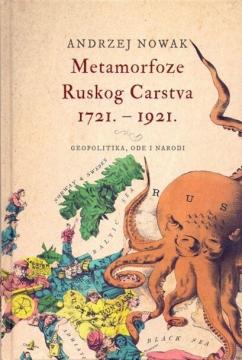
Metamorfoze Ruskog Carstva 1721. - 1921.: Geopolitika, ode i narodi

Metamorfoze Ruskog Carstva 1721. - 1921.: Geopolitika, ode i narodi

Andrzej Nowak

A historical study of the transformations of the Russian Empire from Peter the Great to the early USSR, focusing on imperial geopolitics, ideological patterns, and relations with peoples within the empire.

Metamorphoses of the Russian Empire: 1721–1921 by Andrzej Nowak covers three hundred years of profound political, social, and territorial changes that shaped the Russian imperial idea. Nowak, one of the most famous Polish historians and an expert on Russian-Polish relations, structures the book as a broad analysis of the imperial model — from its fundamental principles to the practical consequences for the peoples that entered the imperial orbit.

The author starts from the transformation of the Muscovite state into the Russian Empire in 1721, under the leadership of Peter the Great. He examines the process of modernization, militarization, and centralization by which Russia built its status as a European power. He focuses on the ideological mechanisms of expansion — the Orthodox mission, the idea of ​​the Third Rome, the concept of patronage over Slavic and Orthodox peoples — as well as the political and military instruments of imperial expansion.

The book describes in detail how the empire expanded towards the Baltic, the Black Sea, the Caucasus, Siberia and the Central Asian steppes, while simultaneously analysing the reactions and resistance of the peoples included in the imperial structure. Nowak emphasises the dual nature of Russian imperialism: on the one hand, the modernising ambition and administrative efficiency, and on the other, the repressive practices, assimilation policies and strategic manipulations that shaped relations with Poles, Ukrainians, Caucasian peoples, Balts and Central Asians.

Special chapters are devoted to the 19th century, the era in which the Russian imperial idea reached its peak and at the same time began to crack under the weight of its own contradictions. The author also sheds light on the key moments of disintegration – the revolution of 1905, the First World War and the revolutions of 1917 – showing how these events ultimately transformed the empire into a Soviet state, but with the continuation of many imperial patterns.

Nowak's approach combines geopolitical analysis, historical narrative, and reflection on ideology, offering a broad and thoughtful interpretation of the Russian imperial project and its lasting consequences for the peoples of Eastern Europe and Eurasia.

Original title
Metamorfozy Imperium Rosyjskiego 1721-1921: geopolityka, ody i narody
Translation
Slaven Kale
Dimensions
23 x 15 cm
Pages
443
Publisher
Fortuna d.o.o., Zagreb, 2023.
 
Latin alphabet. Hardcover.
Language: Croatian.
ISBN
978-9-53770-423-0

One copy is available

Condition:New
 

Are you interested in another book? You can search the offer using our search engine or browse books by category.

You may also be interested in these titles

Kratka povijest ljudske rase

Kratka povijest ljudske rase

Michael Cook

Michael A. Cook, Princeton professor of Islamic history, provides an overview of human history from the Neolithic to the fall of the Twin Towers in 2001 in this witty and intelligent synthesis, asking the key question: why did everything happen exactly th

Profil Knjiga, 2009.
Croatian. Latin alphabet. Paperback.
16.28
Najveće kulture svijeta 1: Egipat

Najveće kulture svijeta 1: Egipat

Ania Skliar

The Greatest Cultures of the World is a collection of eight books that talk about the world's great civilizations. The books were first published in Croatia in 2005 in Rijeka by the publisher Extrada d.o.o., but all eight books were also published specifi

Extrade, 2005.
Croatian. Latin alphabet. Hardcover.
5.72 - 6.36
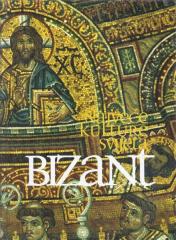
Najveće kulture svijeta 7: Bizant

Najveće kulture svijeta 7: Bizant

Ania Skliar

The Greatest Cultures of the World is a collection of eight books that talk about the world's great civilizations. The books were first published in Croatia in 2005 in Rijeka by the publisher Extrada d.o.o., but all eight books were also published specifi

Extrade, 2005.
Croatian. Latin alphabet. Hardcover.
7.34
Kraj vremena: Revizija proročanstva Maya

Kraj vremena: Revizija proročanstva Maya

Adrian Gilbert

British author Adrian Gilbert (co-author of The Mayan Prophecies from 1995) in The End of Time offers the most thorough and sober modern interpretation of the Mayan calendar and the so-called "2012 prophecy", completely rejecting New Age hysteria.

Stari grad, 2009.
Croatian. Latin alphabet. Hardcover.
18.2212.75 - 18.2412.77
Ciklus svemirskih katastrofa: Potopi, požari i skapavanja u povijesti civilizacije

Ciklus svemirskih katastrofa: Potopi, požari i skapavanja u povijesti civilizacije

Richard Firestone, Allen West, Simon Warwick-Smith

The book is the most readable and complete overview of the evidence that human civilization has already been nearly wiped out of the universe once – and that such cycles may repeat themselves every few tens of thousands of years.

Stari grad, 2007.
Croatian. Latin alphabet. Hardcover.
21.2214.85 - 21.3414.94
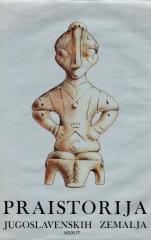
Praistorija jugoslavenskih zemalja II : Neolit

Praistorija jugoslavenskih zemalja II : Neolit

Alojz Benac
Svjetlost, 1979.
Croatian. Latin alphabet. Hardcover with dust jacket.
54.96