Dinamit: Povijest klasnog nasilja u Americi
Antique

Dinamit: Povijest klasnog nasilja u Americi

Louis Adamić

The book documents a century of violence in the American labor movement — from 19th-century mining strikes to bombings and clashes with police — and exposes the brutal background to America's "class war."

The book is a detailed, vivid, and provocative history of labor struggles in the United States from the mid-19th century to the 1930s. Adamič describes the almost continuous violence between workers and capital: mining strikes (the Molly Maguires), massacres such as those at Homestead, Haymarket, Pullman, Ludlow, and numerous bombings, assassinations, and armed conflicts.

He particularly emphasizes the role of dynamite as a symbol of workers' resistance at a time when employers, private armies (the Pinkertons), and the state brutally suppressed strikes. Adamič traces the development of the labor movement, the rise and fall of unions (such as the Industrial Workers of the World – IWW), and shows how violence became part of the American class struggle.

The book is written vividly, almost like a novel, but it is based on thorough research. Adamič, himself an immigrant from Slovenia, writes from a working-class perspective and is critical of American capitalism, but he is not a blind idealist – he also shows the mistakes and violence within the labor movement itself.

Dynamite is a classic work of 20th-century American labor and leftist literature. Today, it is appreciated as an important historical document that exposes the dark side of the "American Dream" and industrialization.

Original title
Dynamite: The Story of Class Violence in America
Translation
Branko Kojić
Dimensions
20 x 14 cm
Pages
354
Publisher
Naklada Binoza, Zagreb, 1933.
 
Latin alphabet. Hardcover with dust jacket.
Language: Croatian.

One copy is available

Condition:Used, very good condition
Damages or inconvenience notice:
  • The cover is missing
Discounted price: 7.245.79
20% discount is valid until 6/28/26 11:59 pm
 

Are you interested in another book? You can search the offer using our search engine or browse books by category.

You may also be interested in these titles

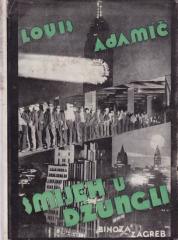
Smijeh u džungli: Autobiografija jednog američkog useljenika

Smijeh u džungli: Autobiografija jednog američkog useljenika

Louis Adamić

An autobiographical work by Louis Adamič, a Slovenian-American writer and one of the most important chroniclers of the immigrant experience in American literature. It ironically and honestly portrays the reality behind the myth of the "land of opportunity

Naklada Binoza, 1932.
Croatian. Latin alphabet. Hardcover with dust jacket.
6.32 - 6.94
Put u Jajce

Put u Jajce

Edvard Kocbek

In Put u Jajce, Edvard Kocbek provides personal and political testimony about key moments in Yugoslav history. The book is based on Kocbek's memories from the Second World War, especially the trip to Jajce in 1943.

Znanje, 1978.
Croatian. Latin alphabet. Hardcover with dust jacket.
8.38
Zanimanje pomorac

Zanimanje pomorac

Bruno Profaca

The book The Occupation of a Seaman by Bruno Profac from 1982 is a collection of reports and stories that depict the everyday life of seafarers.

Grafički zavod Hrvatske (GZH), 1982.
Croatian. Latin alphabet. Paperback.
4.22
Zaboravite da ste imali kćer

Zaboravite da ste imali kćer

Sandra Gregory, Michael Tierney

Sandra Gregory lived a life in Bangkok that one could only dream of until illness, unemployment and political unrest turned it into a nightmare.

Marjan tisak, 2003.
Croatian. Latin alphabet. Paperback.
7.82 - 7.98
Tri sata: Roman međimurskog preokreta 1918.

Tri sata: Roman međimurskog preokreta 1918.

Đuro Vilović

The work, first published in 1935, provides a documentary account of events related to the liberation of Međimurje from Hungarian rule and its annexation to the Kingdom of Serbs, Croats and Slovenes in 1918.

Naklada Binoza, 1935.
Croatian. Latin alphabet. Hardcover.
7.95
Pisma Cosimu I. Mediciju 1566.

Pisma Cosimu I. Mediciju 1566.

Marin Držić

Držić's letters to Cosimo I de' Medici represent a significant document of Croatian Renaissance literature and history. Držić sent three letters to Cosimo I, Grand Duke of Tuscany, between June and August 1566, while he was staying in Florence.

Croatian P.E.N. Centre & Most / The Bridge, 1993.
Croatian. Latin alphabet. Paperback.
8.32