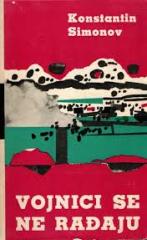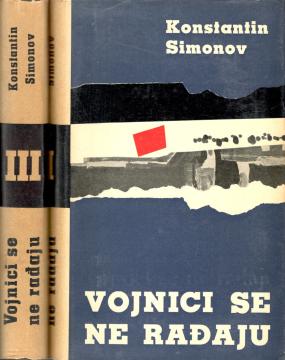
Vojnici se ne rađaju 1-2
Rare book

Vojnici se ne rađaju 1-2

Konstantin Simonov

The novel "Soldiers Are Not Born" by Konstantin Simonov depicts the Red Army's battles on the Stalingrad battlefield and follows soldiers and commanders who mature through the trials of war and become true warriors.

The novel Soldiers Are Not Born by Konstantin Simonov is the second part of the war trilogy that began with the novel The Living and the Dead. The action takes place during the Great Patriotic War, mainly in the area of ​​the Battle of Stalingrad in 1942 and 1943, one of the most important turning points of World War II.

The novel centers on General Fyodor Serpilin, an experienced and capable commander who, after a long unjust imprisonment, is given the opportunity to serve in the army again. He is accompanied by Ivan Sinytsov, a war correspondent who closely follows the lives of soldiers and commanders on the battlefield. Through their fates, the everyday life of war is shown - preparations for attacks, difficult decisions, losses, fear and the responsibility borne by people in positions of power.

Simonov does not portray soldiers as born heroes, but as ordinary people who change under the pressure of war. Experiences on the battlefield, discipline, suffering and solidarity shape them into fighters ready to take on responsibility. The title of the novel emphasizes that a true soldier is not created by birth, but through trials, experience and moral choices.

The work simultaneously depicts great historical events and the personal dramas of individuals. The author emphasizes the importance of command responsibility, interpersonal trust and the price that war demands from a person. The novel is a powerful testimony to the courage, sacrifice and maturation of people in the most difficult war circumstances.

Original title
Солдатами не рождаются
Translation
Nada Cekić
Editor
Aleksandar Flaker
Graphics design
Zlatko Prica
Dimensions
20.8 x 13.7 cm
Pages total
807
Publisher
Naprijed, Zagreb, 1966.
 
Latin alphabet. Hardcover with dust jacket.
Language: Croatian.

The book consists of two volumes.

Jedan višetomni primjerak je u ponudi.
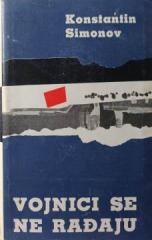
Vojnici se ne rađaju 1-2
Volume 1
Pages: 391
Condition:Used, excellent condition
Vojnici se ne rađaju 1-2
Volume 2
Pages: 416
Condition:Used, excellent condition
 

Are you interested in another book? You can search the offer using our search engine or browse books by category.

You may also be interested in these titles

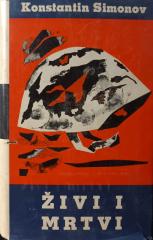
Živi i mrtvi

Živi i mrtvi

Konstantin Simonov

The novel is the first part of Konstantin Simonov's war trilogy, depicting the first years of the Great Patriotic War through the fates of soldiers and civilians, their struggles and attempts to survive the horrors of war.

Naprijed, 1966.
Croatian. Latin alphabet. Hardcover with dust jacket.
8.46
Mati

Mati

Maksim Gorki

Maxim Gorky's novel "Mother" was published in 1906 and is one of the key works of Russian social realism. The work depicts the awakening of the working class in Russia through characters and events that emphasize social injustices and the need for revolut

Svjetlost, 1975.
Croatian. Latin alphabet. Hardcover.
4.26
Poraz

Poraz

Aleksandar Fadeev
Jugoslavijapublik, 1980.
Croatian. Latin alphabet. Hardcover.
4.98
Moskva – Petuški

Moskva – Petuški

Venjedikt Jerofejev

Venedikt Yerofeyev's postmodern prose poem is today considered a classic of new Russian literature. It is compared to Gogol and Kharms for its poetics of absurdity, satire, and metaphysical depth.

LOM, 217.
Serbian. Cyrillic alphabet. Paperback.
11.24
Kreutzerova sonata, Hadži-Murat

Kreutzerova sonata, Hadži-Murat

Lav Nikolajevič Tolstoj

Kreutzer's sonata belongs to those works of Tolstoy that the writer adapted in many ways to his view on moral issues, on marital morality above all.

Civitas, 2004.
Croatian. Latin alphabet. Paperback.
4.98
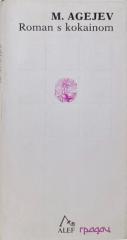
Roman s kokainom

Roman s kokainom

Mihail Agejev

A novel with cocaine is a psychological prose in which the narrator Vadim Maslenikov presents his "case" of moral and physical decay during the turbulent years of Russian history. Mihail Ageyev is the pseudonym of Mark Levi.

Gradac, 1987.
Serbian. Latin alphabet. Paperback with dust jacket.
8.24