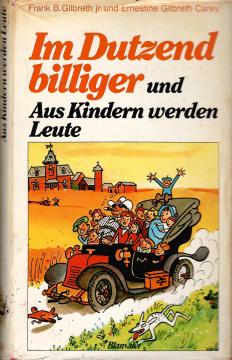
Im Dutzend billiger / Aus Kindern werden Leute

Im Dutzend billiger / Aus Kindern werden Leute

Ernestine Gilbreth-Carey, Frank Bunker Gilbret-Jr.

Memoirs of the Gilbreth family with twelve children, headed by father Frank, a brilliant engineer, and mother Lillian. The first part brings childhood under their father's experiments; the second life after his death.

A humorous memoir of the American Gilbreth family of the early 20th century, co-written by two children, Frank Jr. and Ernestine. Father Frank B. Gilbreth was a prominent industrialist who treated his home with his twelve children as an experimental laboratory: throwing bath balls to practice reaction time, filming children on film, introducing organizational methods to dentistry, and teaching Morse code on the beach. Mother Lillian, a psychologist, was an equal partner in the family ventures.

The first novel, Cheaper by the Dozen, follows the family's childhood in Montclair, New Jersey, from the 1910s until the father's sudden death in 1924. It is filled with anecdotes about how the father applied the principles of scientific management to everyday life, and the mother maintained balance and a sense of humor.

The second novel, Belles on Their Toes, continues after her father's death, as Lillian takes over the family and tries to continue her husband's scientific mission, confronting prejudice against women in academia and the business world, and raising her children through adolescence and adulthood. Together, the two volumes form a touching and humorous portrait of a family in which love, pedagogy, and eccentricity are inseparable.

Original title
Cheaper by the Dozen / Belles on Their Toes
Illustrations
Hans Kossatz
Graphics design
Klaus Renner
Dimensions
21 x 13 cm
Pages
351
Publisher
Blanvalet, München
 
Latin alphabet. Hardcover with dust jacket.
Language: German.

One copy is available

Condition:Used, very good condition
Damages or inconvenience notice:
  • Slight damage to the dust jacket
 

Are you interested in another book? You can search the offer using our search engine or browse books by category.

You may also be interested in these titles

Rakova obratnica

Rakova obratnica

Henry Miller

This is an accusation, a slander, a personal insult. This is not a book, in the ordinary sense of the word. No, this is a continuous insult, a spit in the face of Art, a foot in the tur against God, Man, Fate, Time, Love, Beauty...whatever you want.

Šareni dućan, 2006.
Croatian. Latin alphabet. Paperback.
11.468.02
Priče iz doba jazza

Priče iz doba jazza

Francis Scott Fitzgerald

F. Scott Fitzgerald, the messenger of a lost generation, paints a portrait of the era between the two wars in this collection of eleven stories: hedonism that bites, moral decay that intoxicates, and youth that burns like fireworks.

Šareni dućan, 2009.
Croatian. Latin alphabet. Paperback.
11.248.99
Gregov dnevnik: Točka na i

Gregov dnevnik: Točka na i

Jeff Kinney

Greg's Diary: The Last Stand is the third installment of the hilariously funny Greg's Diary. The hilarious new installment will delight many fans of this children's favorite scoundrel.

Algoritam, 2013.
Croatian. Latin alphabet. Hardcover.
8.46
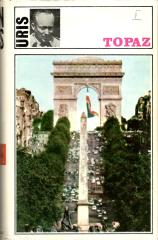
Topaz

Topaz

Leon Uris

Topaz is a Cold War suspense novel by Leon Uris, published in 1967 by McGraw-Hill. The novel spent one week atop The New York Times Best Seller List, and was Uris's first New York Times number-one bestseller since Exodus in 1959.

Otokar Keršovani, 1970.
Croatian. Latin alphabet. Hardcover with dust jacket.
8.68
Čovjek vrijedan zlata

Čovjek vrijedan zlata

Joseph Heller

Bruce Gold, a literature professor and Jewish man from Brooklyn, is offered a chance to become a high-ranking official in Washington. While trying to write a book about the Jewish experience, he becomes entangled in the absurd world of politics, confronti

Otokar Keršovani, 1987.
Croatian. Latin alphabet. Paperback.
The book consists of two volumes
6.32
Jarčeva obratnica

Jarčeva obratnica

Henry Miller

Tropic of Capricorn is another legendary erotic novel by Henry Miller, published in 1938. Due to the inserted philosophy, it is somewhat difficult to understand. In this work, Henry is in Paris, but he actually remembers his childhood in New York.

Otokar Keršovani, 1968.
Croatian. Latin alphabet. Hardcover.
5.72 - 5.86