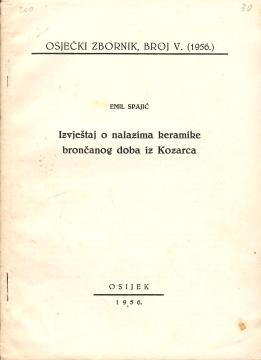
Izvještaj o nalazima keramike brončanog doba iz Kozarca
Rare book

Izvještaj o nalazima keramike brončanog doba iz Kozarca

Emil Spajić

Emil Spajić's study presents the results of archaeological research at the Bronze Age site in Kozarac in Baranja and analyzes the settlement, cultural layer, and ceramic finds.

In this archaeological study, Emil Spajić presents the results of research on the Bronze Age site in Kozarac in Baranja. Based on excavations conducted in a brickyard, he describes the location of the site, the stratigraphy of the cultural layer, and numerous finds that testify to the existence of a prehistoric settlement. Among the objects found, hearths, a stone axe, a hand mill, animal bones, shells, bone artifacts, and a large number of ceramic fragments stand out. The author pays special attention to the typology of ceramics, distinguishing coarser utilitarian vessels from more finely crafted, decorated specimens, and connects them with the Pannonian Bronze Age group and finds from Dubovac – Žuti Brdo, while noting local characteristics. The study concludes that Kozarac was a significant Bronze Age settlement and represents a valuable contribution to the knowledge of the prehistory of Baranja and cultural connections in the area of ​​southern Pannonia.

Illustrations
Dragutin Vukasović
Dimensions
24 x 17 cm
Pages
24
Publisher
Muzej Slavonije, Osijek, 1956.
 
Latin alphabet. Paperback.
Language: Croatian.

One copy is available

Condition:Used, excellent condition
 

Are you interested in another book? You can search the offer using our search engine or browse books by category.

You may also be interested in these titles

Nalazište mlađeg željeznog doba s terena Osijeka (nastavak)

Nalazište mlađeg željeznog doba s terena Osijeka (nastavak)

Emil Spajić

The study analyzes the Celtic necropolis in Osijek, revealing the simultaneous use of cremation and burial of the deceased. The findings indicate strong Celtic and Illyrian cultural influences and developed metal production.

Muzej Slavonije, 1962.
Croatian. Latin alphabet. Paperback.
11.32
Književnost ranog novovjekovlja u Boki Kotorskoj: Hrestomatija za studente

Književnost ranog novovjekovlja u Boki Kotorskoj: Hrestomatija za studente

Viktoria Franić Tomić, Slobodan Prosperov Novak

This student handbook is the most comprehensive presentation to date of the literary heritage of the Bay of Kotor in the early modern period, from the late Renaissance to the Baroque, in which the authors offer a chronological and thematic overview of the

Hrvatska sveučilišna naklada, 2015.
Croatian. Latin alphabet. Paperback.
18.34
Četvrti znanstveni sabor Slavonije i Baranje, sv. 2

Četvrti znanstveni sabor Slavonije i Baranje, sv. 2

The Fourth Scientific Congress of Slavonia and Baranja, Vol. 2, brings together papers from education, culture, science, informatics, economics and technology, with an emphasis on the development problems and opportunities of the region.

Jugoslavenska akademija znanosti i umjetnosti (JAZU), 1986.
Croatian. Latin alphabet. Hardcover with dust jacket.
17.46
Besede: Izbor iz svetskog besedništva

Besede: Izbor iz svetskog besedništva

„Predigten: Eine Auswahl aus der Welt der Redekunst“ ist eine Anthologie der Redekunst, herausgegeben von Vera Popović, mit einem Vorwort von Živojin Simić. Bis auf wenige Ausnahmen wurden die Predigten dieser Sammlung nun entweder erstmals übersetzt oder

Kultura, 1967.
Serbian. Latin alphabet. Hardcover.
12.98
Jesu li bogovi bili astronauti?

Jesu li bogovi bili astronauti?

Ernst von Khuon

Laut Daeniken verdankt die Menschheit den Aufstieg ihrer Kultur Astronauten von anderen Sternen. In diesem Buch diskutieren zahlreiche führende Experten Erich von Daenikens Thesen.

Stvarnost, 1972.
Croatian. Latin alphabet. Paperback.
4.98
Ukrajinski Karpati: Etnogeneza, arheologija, etnologija

Ukrajinski Karpati: Etnogeneza, arheologija, etnologija

Die Sammlung bildet eine interdisziplinäre Brücke zwischen ukrainischer und kroatischer Wissenschaft und fördert vergleichende Forschungen zu slawischen Migrationen. Sie präsentiert die Karpaten als einen „lebendigen Archipel“, der Ost und West verbindet

Filozofski fakultet Sveučilišta u Zagrebu, 2014.
Croatian. Latin alphabet. Paperback.
18.34