Filosofska pisma

Filosofska pisma

Petar Čaadajev
Čaadajev

A provocative philosophical reflection on Russian history, the relationship between Russia and Europe, and the role of Christianity in the development of civilization. A work that sparked one of the most important debates in Russian thought.

Philosophical Letters is the most important work of Pyotr Chaadayev, a Russian philosopher and one of the pioneers of modern Russian philosophical thought. Written in French between 1829 and 1831, this collection of eight letters explores Russia's historical destiny, the relationship between East and West, and the spiritual foundations of European civilization.

Chaadayev views history as a process of humanity's moral and spiritual development, in which Christianity plays a central role. He is particularly preoccupied with the question of why Russia, in his view, remained outside the key cultural and intellectual currents of European history.

The publication of the first letter in 1836 sparked a political scandal. Tsarist authorities banned the journal in which the text appeared, declared Chaadayev mentally ill, and placed him under surveillance. His critique of Russian society ignited a long-standing debate between Westernizers and Slavophiles regarding Russia's identity, tradition, and future.

Philosophical Letters is not merely a critique of a nation and its history, but also a philosophical reflection on the relationship between faith, reason, freedom, and historical progress. The work is essential for understanding 19th-century Russian philosophy and the intellectual debates concerning Russia's relationship with Europe.

Translation
Ljudmila Joksimović
Editor
Filip Medenica
Dimensions
21.5 x 13 cm
Pages
156
Publisher
Logos, Beograd, 2000.
 
Cyrillic alphabet. Paperback.
Language: Serbian.

One copy is available

Condition:Used, excellent condition
 

Are you interested in another book? You can search the offer using our search engine or browse books by category.

You may also be interested in these titles

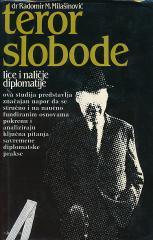
Teror slobode : lice i naličje diplomatije

Teror slobode : lice i naličje diplomatije

Radomir Milašinović

Radomir Milašinović's 1983 political and philosophical study analyzes the paradoxes of modern freedom. Through a critique of social structures and ideologies, the author explores the limits of the individual within the system.

Jugoart, 1983.
Croatian. Latin alphabet. Hardcover with dust jacket.
9.98 €
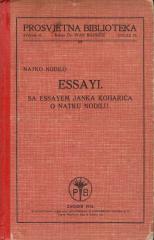
Essayi

Essayi

Natko Nodilo

The essays gather political, historical and cultural essays by Natko Nodil in which he discusses national identity, liberalism, religion and society, with an accompanying essay by Janko Koharić on the author's life and work.

Hrvatski štamparski zavod d.d., 1918.
Croatian. Latin alphabet. Hardcover.
11.32 €
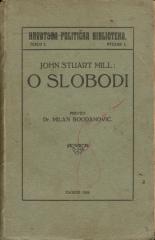
O slobodi

O slobodi

Mill
John Stuart Mill

The founder of modern liberalism, John Stuart Mill, in his essay "On Liberty" defends individual freedom from social and state pressure, setting limits on power over the individual and advocating freedom of thought, speech, and action.

Hrvatska tiskara, 1918.
Croatian. Latin alphabet. Paperback.
16.24 €
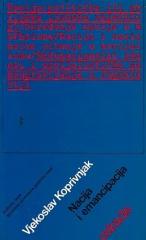
Nacija i emancipacija

Nacija i emancipacija

Vjekoslav Koprivnjak

A political science and sociological study that, through critical theory and Marxist discourse, analyzes the relationship between the national question, social emancipation, class struggle, and contemporary political processes.

Centar za kulturnu djelatnost (Cekade), 1986.
Croatian. Latin alphabet. Paperback.
12.98 €
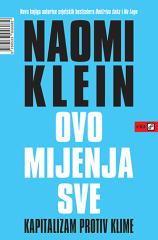
Ovo mijenja sve: Kapitalizam protiv klime

Ovo mijenja sve: Kapitalizam protiv klime

Naomi Klein

In her most provocative book yet, Naomi Klein, author of the influential bestsellers "No Logo" and "The Shock Doctrine," explores the greatest threat humanity has ever faced: the war that the existing economic model is waging against life on Earth.

V.B.Z, 2015.
Croatian. Latin alphabet. Paperback.
11.48 €
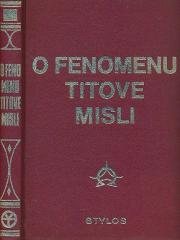
O fenomenu Titove misli

O fenomenu Titove misli

Milan Dukić

Milan Dukić’s book *On the Phenomenon of Tito’s Thought* (1976) is a theoretical study. It analyzes the ideological, philosophical, and political influence of Josip Broz Tito on self-managing socialism and the doctrine of non-alignment.

Stylos, 1976.
Croatian. Latin alphabet. Hardcover.
4.52 €