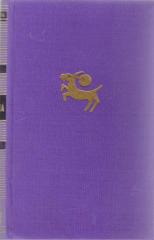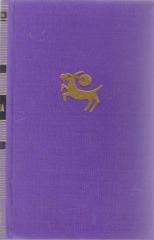
Povijest talijanske književnosti

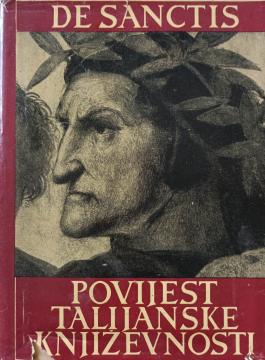
Povijest talijanske književnosti

Francesco de Sanctis
Original title
Storia della letteratura italiana
Translation
Ivo Frangeš
Editor
Oleg Mandić
Graphics design
Valerija Pavić
Dimensions
22 x 16.5 cm
Pages
747
Publisher
Matica hrvatska, Zagreb, 1955.
 
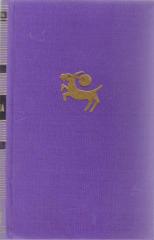
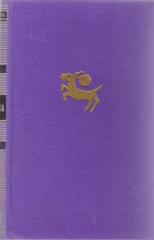
Latin alphabet. Hardcover with dust jacket.
Language: Croatian.

One copy is available

Condition:Used, good condition (visible signs of use)
Damages or inconvenience notice:
  • Traces of patina
  • Damaged book cover
 

Are you interested in another book? You can search the offer using our search engine or browse books by category.

You may also be interested in these titles

Sinovi bijelog medvjeda

Sinovi bijelog medvjeda

Thea Dalla Cola
Školska knjiga, 1969.
Croatian. Latin alphabet. Hardcover.
4.98
Priča o skočimišu

Priča o skočimišu

Lino Minarelli
Školska knjiga, 1969.
Croatian. Latin alphabet. Hardcover.
4.88
Milion – Putovanja Marka Pola

Milion – Putovanja Marka Pola

Marco Polo

Milion is an account of Marco Polo's travels in Asia, which he undertook between 1271 and 1295, and his experiences at the court of Kublai Khan, the greatest Eastern ruler of the time, in whose service Marco was for almost 17 years.

Marjan tisak, 2004.
Croatian. Latin alphabet. Paperback.
8.26
Pismo nerođenom djetetu

Pismo nerođenom djetetu

Oriana Fallaci

One of the most moving and courageous works of world literature of the 20th century. Written as a long monologue by a pregnant woman (Fallaci herself), the book is at once an intimate confession, a feminist manifesto, and a philosophical confrontation wit

Znanje, 2009.
Croatian. Latin alphabet. Paperback.
4.56
Dekameron

Dekameron

Giovanni Boccaccio

In the Decameron, ten young people fleeing the plague tell stories about love, fate and ingenuity. The adapted version of Ljerka Car Matutinović brings selected novellas, adapted to school, with an emphasis on humor, morality and Renaissance spirit.

Mozaik knjiga, 2002.
Croatian. Latin alphabet. Hardcover.
5.76
U sjeni bregova

U sjeni bregova

Paola Drigo

The novel depicts the tragic fate of Mariuta (Marije Zef) and her younger sister Rosuta. The work shocked contemporaries with its boldness in depicting taboo subjects, and is today considered a classic portrait of female suffering in rural Italy.

Matica hrvatska, 1961.
Croatian. Latin alphabet. Hardcover with dust jacket.
5.32