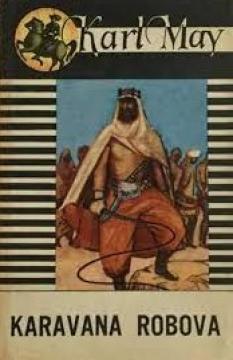
Karavana robova

Karavana robova

Karl May

The adventure novel begins with the journey of a stranger named Father with Four Eyes (he wears glasses) to Fashoda (Sudan) accompanied by the Homra tribe.

He is a cunning German who travels the world and collects a wide variety of plants and animals in order to expand his knowledge of that part of the world. He soon discovers that the Homri cannot be trusted and that they are plotting to kill him. From the circling of the vultures, he realizes that they are being followed by another caravan, the so-called gazua (robber caravan). The Homri's plans are thwarted by a merchant caravan, the djelabah, which joins them.

Original title
Sklaven Karawane
Translation
Dragutin Bohuš
Graphics design
Zdenko Balabanić
Dimensions
18 x 12 cm
Pages
459
Publisher
Otokar Keršovani, Rijeka, 1964.
 
Latin alphabet. Paperback.
Language: Croatian.

One copy is available

Condition:Used, very good condition
Damages or inconvenience notice:
  • The cover is missing
  • Traces of patina
 

Are you interested in another book? You can search the offer using our search engine or browse books by category.

You may also be interested in these titles

Blago u Srebrnom jezeru

Blago u Srebrnom jezeru

Karl May
Otokar Keršovani, 1965.
Croatian. Latin alphabet. Paperback.
3.99
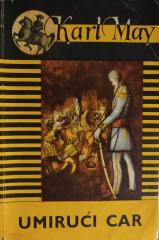
Umirući car

Umirući car

Karl May
Otokar Keršovani, 1963.
Croatian. Latin alphabet. Paperback.
2.99
Benito Juarez

Benito Juarez

Karl May
Otokar Keršovani, 1963.
Croatian. Latin alphabet. Paperback.
3.18
Razbojnici

Razbojnici

Friedrich Schiller

"The Robbers" (1781), Friedrich Schiller's first play, is a key work of the German Sturm und Drang movement, which explores themes of freedom, justice, moral conflict, and rebellion against social norms.

August Cesarec, 1987.
Croatian. Latin alphabet. Paperback.
3.36 - 3.48
Prodane djevojke

Prodane djevojke

Hedwig Courths-Mahler

A classic sentimental romance novel with motifs of inheritance, intrigue, class differences and happy love that overcomes obstacles. The main character is the young Rose Rietberg, a beautiful and noble girl who is orphaned at an early age.

Nakladni zavod Matice hrvatske, 1987.
Croatian. Latin alphabet. Hardcover with dust jacket.
6.98
Proces

Proces

Franz Kafka

Kafka wrote The Process between 1914 and 1915, published posthumously in 1925. The novel is unfinished but with an added final chapter by Max Brod. Edition with a foreword by B. Živojinović and an afterword by Walter Killi.

BIGZ, 1990.
Serbian. Latin alphabet. Paperback.
4.26