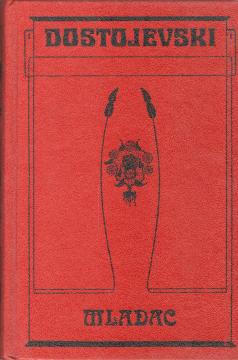
Mladac

Mladac

Fjodor Mihajlovič Dostojevski

The Young Man (1875) by Fyodor Dostoevsky is a complex novel about coming of age, moral struggles, and social conflicts in 19th-century Russia. The novel, although less well-known, is a powerful portrayal of internal struggle and social tensions, with an

The narrator is Arkady Dolgoruky, a twenty-year-old young man, the illegitimate son of the nobleman Versilov, who struggles with feelings of inferiority and seeks his place in the world. Arkady arrives in St. Petersburg carrying a letter that could compromise prominent figures, including the young widow Catherine.

His relationship with Versilov, a charismatic but unstable father, is marked by admiration and disappointment. Versilov's ambiguous relationship with Catherine and his philosophical ideas about Russia and Europe further complicate the plot. Arkady becomes involved in social intrigue, gambling, and conflict, trying to prove his worth. His obsession with the "idea" of wealth and power reflects an internal struggle between ideals and selfishness.

The novel explores themes of generational conflict, the trauma of illegitimate origins, and the search for identity. Through Arkady's experiences, Dostoevsky criticizes the moral emptiness of the aristocracy and the nihilistic tendencies of youth. Supporting characters, such as the old man Makar, bring a spiritual dimension, while complex relationships reveal Dostoevsky's psychological depth. The Young Man ends with Arkady maturing, embracing more modest ideals, and coming to terms with his past.

Prijevod
Zlatko Crnković
Urednik
Jakša Kušan
Naslovnica
Boris Dogan
Dimenzije
21 x 14 cm
Broj strana
524
Nakladnik
Znanje, Zagreb, 1982.
 
Latinica. Tvrde korice.
Jezik: Hrvatski.

Jedan primjerak je u ponudi

Stanje:Korišteno, u odličnom stanju
Snižena cijena: 11,508,63
Popust od 25% vrijedi do 22.03.2026. 23:59
Dodano u košaricu!
 

Zanima Vas i neka druga knjiga? Možete pretražiti našu ponudu pomoću tražilice ili prelistati knjige po kategorijama.

Možda će Vas zanimati i ovi naslovi

Ujakov san / Poniženi i uvrijeđeni

Ujakov san / Poniženi i uvrijeđeni

Fjodor Mihajlovič Dostojevski

Both works reflect Dostoevsky's early phase, with a focus on social criticism, psychological analysis and moral dilemmas, foreshadowing the themes of his later masterpieces.

Znanje, 1982.
Hrvatski. Latinica. Tvrde korice.
13,269,28
Selo Stepančikovo

Selo Stepančikovo

Fjodor Mihajlovič Dostojevski

"The Village of Stepanchikovo" is a humorous novel by Dostoyevsky, first published in 1859. This novel, which differs from the later, darker works of the author, is a satirical critique of social relations and human weaknesses.

Svjetlost, 1962.
Srpski. Latinica. Broširano.
4,22 - 4,76
Pustolovine Toma Sawyera

Pustolovine Toma Sawyera

Mark Twain

The Adventures of Tom Sawyer is the first truly realistic children's novel, not only in American but also in world children's literature. Twain's most famous work and a favorite children's book in which the writer described his boyhood experiences.

Nakladni zavod Hrvatske, 1947.
Hrvatski. Latinica. Tvrde korice.
16,32
Dok ležah na samrti

Dok ležah na samrti

William Faulkner

Faulkner's 1930 novel, a classic example of modernist literature. It is often compared to Joyce's "Ulysses" for its innovative structure, but is more accessible due to its focus on family.

Rad, 1985.
Hrvatski. Latinica. Broširano.
3,26
Proces

Proces

Franz Kafka

Kafka wrote The Process between 1914 and 1915, published posthumously in 1925. The novel is unfinished but with an added final chapter by Max Brod. Edition with a foreword by B. Živojinović and an afterword by Walter Killi.

BIGZ, 1990.
Srpski. Latinica. Broširano.
4,26
Jedna Svanova ljubav

Jedna Svanova ljubav

Marcel Proust
Rad, 1984.
Srpski. Latinica. Broširano.
2,98