Erich Maria Remarque
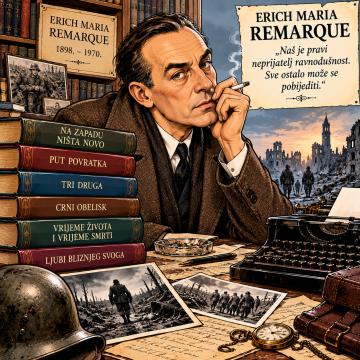
Erich Maria Remarque (1898–1970)—born Erich Paul Remark—was a German writer and one of the most renowned figures of 20th-century anti-war literature. He was born on June 22, 1898, in Osnabrück and died on September 25, 1970, in Locarno, Switzerland. His works are characterized by criticism of war, humanism, the "Lost Generation," and the quest for human dignity.
He grew up in a modest family and was conscripted into the German army during World War I. In 1917, he was wounded on the Western Front. His wartime experiences profoundly shaped his literary worldview and became the foundation for his most famous novels.
He achieved worldwide fame with the novel All Quiet on the Western Front (Im Westen nichts Neues, 1929), a harrowing portrayal of the fate of young German soldiers during World War I. The work became one of the most important anti-war novels in world literature and has been adapted for the screen multiple times.
In the novel The Road Back (1931), he depicts the difficulties war veterans faced in returning to civilian life, while Three Comrades (1936/1937) tells a story of friendship, love, and uncertainty in Germany during the interwar period.
After the Nazis came to power, his works were banned and publicly burned. In 1938, he was stripped of his German citizenship and subsequently emigrated to the United States.
In the novel Flotsam (1941), he describes the fates of political refugees, while Arch of Triumph (1945) depicts the lives of émigrés in Paris on the eve of the Second World War. These were followed by Spark of Life (1952), A Time to Live and a Time to Die (1954), The Black Obelisk (1956), and The Night in Lisbon (1962)—works dedicated to war, exile, totalitarianism, and the moral trials faced by the individual.
The novel Shadows in Paradise (1971) was published posthumously, continuing to explore the themes of the émigré experience and the loss of one's homeland.
Remarque’s style is characterized by simple yet powerful expression, psychological authenticity, and deep compassion for human destinies. His novels remain an enduring literary testament to the futility of war, the destruction of human lives, and the importance of peace, love, and solidarity.
Naslovi u ponudi

Izabrana djela 3: Tri ratna druga
Three World War I comrades—Robbie, Otto, and Gottfried—try to survive in Weimar Germany in 1928. Amid economic crisis, poverty, and political violence, their friendship is their only refuge.

Izabrana djela 4: Ljubi bližnjega svoga
„Ljubi bližnjeg svog“ prikazuje sudbinu izbeglica koje beže od nacizma i traže sigurno utočište u Evropi. Roman govori o strahu, progonu, ljubavi i borbi za dostojanstven život.

Izabrana djela 5: Trijumfalna kapija
Pariz 1939. Njemački liječnik izbjeglica Ravic živi bez dokumenata i domovine. Usred nadolazećeg rata pronalazi strastvenu ljubav, ali i priliku za osvetu. Klasik o izgnanstvu i ljudskosti.

Izabrana djela 6: Iskra života
„Iskra života“ prati grupu zatvorenika u nacističkom koncentracionom logoru koji, uprkos stalnom teroru, zadržavaju svoju moralnu snagu i čovečnost. Roman prikazuje borbu duha protiv sistematskog uništenja i potrebu za nadom.

Izabrana djela 7: Doba života i doba smrti
„Doba života i doba smrti“ prati nemačkog vojnika Ernsta Grebera, koji dolazi na odsustvo tokom Drugog svetskog rata i pokušava da pronađe smisao života usred razaranja, ljubavi i moralnih dilema.

Izabrana djela 8: Crni obelisk
The Black Obelisk depicts life in Germany after the First World War. Young Ludwig Bodmer tries to find the meaning of life in the midst of poverty, inflation, political unrest and disappointment.

Izabrana djela 9: Nebo ne zna za miljenike
Nebo ne zna za miljenike prati automobilskog vozača Clerfayta i teško bolesnu Lillian. Svjesni prolaznosti života, zajedno traže sreću, ljubav i slobodu prije nego što bude prekasno.

Izabrana djela 9: Nebo ne zna za miljenike
„Der Himmel Kennt Keine Günstlinge“ erzählt die Geschichte des Autofahrers Clerfayt und der schwerkranken Lillian. Im Bewusstsein der Vergänglichkeit des Lebens suchen sie gemeinsam nach Glück, Liebe und Freiheit, bevor es zu spät ist.


Ljubi bližnjega svoga
Roman Ljubi bližnjeg svog prati sudbine izbeglica koje beže od progona tokom Drugog svetskog rata. U borbi za opstanak, oni pokušavaju da sačuvaju svoje dostojanstvo, nadu i čovečnost.