Apulej
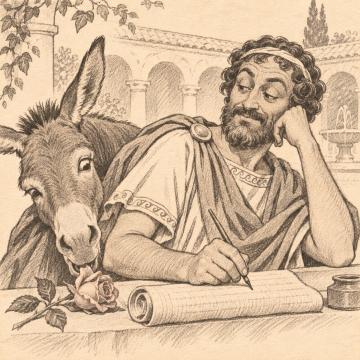
In Apuleius, a rose can mean more than courtship. If you’ve accidentally turned yourself into a donkey, it might make you human again. Lucius, the hero of The Golden Ass (Metamorphoses, also known as Asinus aureus), finds this out when hay is considerably easier to come by than flowers. He meant to try a spell that would turn him into a bird and ended up with long ears and no way of explaining the mix-up. The ears do come in handy. People say all sorts of things in front of a donkey that they’d keep to themselves in front of a man.
Apuleius was born around AD 125 in Madaura, in Roman North Africa, in what is now Algeria. He was a Platonist philosopher and a celebrated public speaker. When relatives of the wealthy widow Pudentilla accused him of using magic to win her hand, he defended himself in court. That defence survives as the Apologia, also known as De magia (On Magic). The Florida preserves twenty-three excerpts from his speeches. They give a sense of how the same author held an audience when he didn’t have a donkey to do the talking for him.
The Golden Ass is the only Roman novel to survive complete. Across its eleven books, Lucius passes from one owner to another and hears a succession of tales, the best known being that of Cupid and Psyche. Curiosity makes trouble for Psyche too. She wants to see the face of her mysterious lover, just as Lucius wants a closer look at how magic works. Apuleius grants both wishes and leaves the two to make what they can of the discovery. Towards the end, the goddess Isis enters Lucius’s story and the adventure takes on the character of a religious conversion.
Arka’s catalogue lists a 1954 edition under the title Zlatni magarac. The tales Lucius overhears are reason enough to open it. A donkey may be unable to interrupt a storyteller, but he gets to hear things other listeners would never be told.
Titles in our offer
