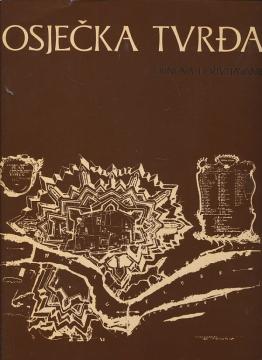
Osječka Tvrđa - Plan obnove i oživljavanja

Osječka Tvrđa - Plan obnove i oživljavanja

This book focuses on the restoration and revitalization plan of the Osijek Fortress, an important historical and architectural site in Osijek.

Osječka Tvrđa is a baroque military fort from the 18th century, located on the right bank of the Drava River. Construction began in 1712 under the supervision of Prince Eugene of Savoy, and was mostly completed by 1722.

After the liberation of Osijek from Ottoman rule in 1687, the Austrian military authorities decided to build a new fortress at the strategically important crossing over the Drava1. The fortress was built on the model of Dutch lowland fortifications, and was designed by Mathias von Kaiserfeld and Maximilian Gosseau de Henef.

The fortress was a multi-ethnic town in the 18th and 19th centuries, where local residents and immigrants from various parts of Europe lived, including Styria, Carniola, Bavaria, Italy, France and others1. The official languages ​​were Latin and German, but other languages ​​such as Modern Greek, Italian and French were also spoken.

Today, the Fortress is known for its Baroque buildings, including churches, museums, schools and other public buildings. Although many of the fortifications were removed in the 1920s, the inner core of the fortress remained preserved.

Editor
Radovan Miščević
Illustrations
Zvonimir Barbarić, Jovan Gojković, Rudolf Bartolović
Graphics design
Zdravko Beretin, Radovan Miščević, Mirjana Petković
Dimensions
32 x 23 cm
Pages
105
Publisher
Urbanistički institut SR Hrvatske, Zagreb, 1976.
 
Latin alphabet. Paperback.
Language: Croatian.

One copy is available

Condition:Used, excellent condition
 

Are you interested in another book? You can search the offer using our search engine or browse books by category.

You may also be interested in these titles

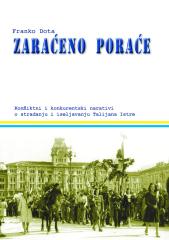
Zaraćeno poraće: Konfliktni i konkurentski narativi o stradanju i iseljavanju Talijana Istre

Zaraćeno poraće: Konfliktni i konkurentski narativi o stradanju i iseljavanju Talijana Istre

Franko Dota

The book analyzes how conflicting historical narratives about the suffering and mass emigration of Italians from Istria and Rijeka developed in Croatia and Italy after World War II (1943–1956), debunking myths and encouraging an empathetic approach to the

Srednja Europa, 2010.
Croatian. Latin alphabet. Paperback.
11.329.06
Numizmatička povijest Rijeke

Numizmatička povijest Rijeke

Bože Mimica

This book covers the coins that circulated in the Rijeka area over a period of twenty-five centuries. Each period, from antiquity to 1918, is accompanied by a brief historical overview of Rijeka.

Povijesno društvo, 1997.
Croatian. Latin alphabet. Paperback.
17.98
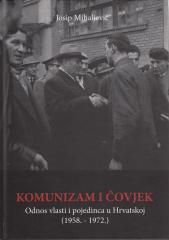
Komunizam i čovjek: Odnos vlasti i pojedinca u Hrvatskoj (1958.–1972.)

Komunizam i čovjek: Odnos vlasti i pojedinca u Hrvatskoj (1958.–1972.)

Josip Mihaljević

Knjiga Josipa Mihaljevića analizira odnos vlasti i pojedinca u komunističkoj Hrvatskoj (1958.–1972.), kroz represivne mehanizme, ideološke pritiske i ograničenja osobne slobode u socijalističkom sustavu.

Hrvatski institut za povijest, 2016.
Croatian. Latin alphabet. Hardcover.
17.26
Židovski Osijek

Židovski Osijek

Ljiljana Dobrovšak, Andreja Simičić, Davor Špišić, Marina Vinaj, Tomislav Vuković

Brošura je namijenjena nastavnicima, učenicima i svima zainteresiranima za podučavanje tema židovskog naslijeđa, antisemitizma i holokausta.

Nansen dijalog centar, 2020.
Croatian. Latin alphabet. Paperback.
4.76
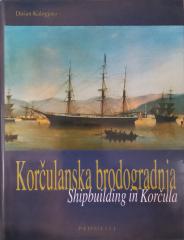
Korčulanska brodogradnja / Shipbuilding in Korčula

Korčulanska brodogradnja / Shipbuilding in Korčula

Dušan Kalogjera

Monografija Korčulanska brodogradnja autora Dušana Kalogjere istražuje bogatu povijest brodogradnje na otoku Korčuli, ključnom središtu jadranske pomorske tradicije od srednjeg vijeka do suvremenosti.

Prometej, 1998.
Croatian. Latin alphabet. Hardcover with dust jacket.
87.32
Hrvatski narodni vladari od god. 620.–1102.

Hrvatski narodni vladari od god. 620.–1102.

Mate Sagher

A pioneering attempt at a systematic presentation of Croatian political history from the settlement of Croats to the conclusion of a personal union with Hungary. Segher chronologically traces the development of Croatian statehood, relying on the sources a

Dionička tiskara, 1903.
Croatian. Latin alphabet. Paperback.
14.76