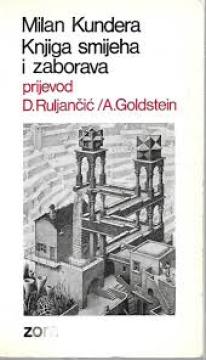
Knjiga smijeha i zaborava

Knjiga smijeha i zaborava

Milan Kundera

The novel The Book of Laughter and Forgetfulness (1979), a fragmentary novel in seven parts, explores Czech history under the communist regime, particularly after the 1968 Prague Spring and the Soviet invasion.

Kundera, an exile in Paris, combines satire, erotic motifs, and philosophical digressions, mocking totalitarianism through stories of the manipulation of memory and identity.

Through characters such as Ludvik, an engineer rehabilitated after a false accusation, and Tamara, who flees into exile, the novel depicts how the regime erases the past – from destroyed monuments to betrayals by friends – while laughter becomes a weapon: angelic (liberating, individual) versus diabolical (collective, destructive). Erotic scenes, such as those between lovers in Paris or during the invasion, emphasize the lightness and heaviness of existence, the conflicts of mind and body, public and private.

Kundera warns that forgetting is not a passive loss, but an active erasure: just as the image of Clementis is erased from history from a photograph next to Gottwald, so personal memories are extinguished. The novel, written in Czech and translated into English, criticizes false narratives and celebrates art as resistance. Relevant in an age of manipulation, Kundera sees it as a "novel of ideas" where history becomes a metaphor for loneliness and hope in laughter.

Original title
Kniha smíchu a zapomnění
Translation
Albert Goldštajn, Dagmar Ruljančić
Editor
Vjeran Zuppa
Graphics design
Sanja Iveković
Dimensions
19 x 12 cm
Pages
262
Publisher
Grafički zavod Hrvatske (GZH), Zagreb, 1982.
 
Latin alphabet. Paperback.
Language: Croatian.

One copy is available

Condition:Used, excellent condition
Damages or inconvenience notice:
  • Poruka lične prirode
 

Are you interested in another book? You can search the offer using our search engine or browse books by category.

You may also be interested in these titles

Priče o smrti

Priče o smrti

Vladimir Jovičić
Narodna knjiga, 1987.
Serbian. Latin alphabet. Paperback with dust jacket.
1.50
Vreća kostiju

Vreća kostiju

Stephen King

Der Roman handelt von Mike Noonan, einem erfolgreichen Schriftsteller, der nach dem Tod seiner Frau unter einer Schreibblockade und Albträumen leidet. Vier Jahre später beschließt er, sich in ihr Sommerhaus zurückzuziehen, wo er mit übernatürlichen Phänom

Algoritam, 2000.
Croatian. Latin alphabet. Hardcover.
72.34
Konjički gambit

Konjički gambit

William Faulkner

„To nikada nije bila samo igra koja je odražavala svu ljudsku strast i nadu i ludilo, a onda se ostvarila. „Dobro“, reče mladić, „nemoj kasnije da kažeš da nisi upozoren“.

Izdavački zavod Jugoslavija, 1967.
Serbian. Latin alphabet. Paperback.
4.98
Ništa nas ne smije iznenaditi

Ništa nas ne smije iznenaditi

Ante Tomić

Ova duhovita proza iz JNA, sa nizom likova koji će nas nasmejati do glasa, plastično ocrtava sirovost, ali i sitna zadovoljstva koja su sposobniji vojnici mogli da dožive u najdosadnijoj godini života.

Fraktura, 2003.
Croatian. Latin alphabet. Paperback.
7.98
U sjeni procvalih djevojaka, sv. 1-2 (Zavičajna imena-zavičaj, oko gospođe Swann)

U sjeni procvalih djevojaka, sv. 1-2 (Zavičajna imena-zavičaj, oko gospođe Swann)

Marcel Proust
Zora, 1965.
Croatian. Latin alphabet. Hardcover with dust jacket.
The book consists of two volumes
4.48 - 8.24
Strasti i druge pripovijetke

Strasti i druge pripovijetke

Isaac Bashevis Singer

Dobitnik Nobelove nagrade za književnost 1978. godine, Isak Baševis Singer, vrstan je pisac novela i kratkih priča. I u ovoj zbirci pripovjedaka izražena je autorova sklonost ka mistici, groteski, folkloru i erotici.

Svjetlost, 1986.
Croatian. Latin alphabet. Hardcover with dust jacket.
6.42