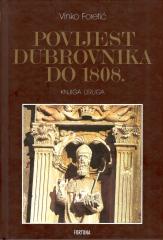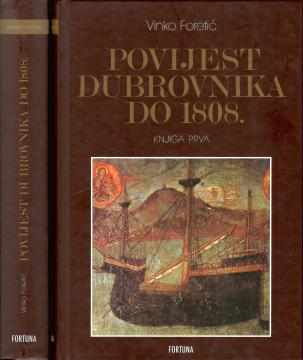
Povijest Dubrovnika do 1808.

Povijest Dubrovnika do 1808.

Vinko Foretić

The development of Dubrovnik from the Middle Ages to the abolition of the Republic, through politics, society and trade. Reprint of the first edition from 1980, which has an index of authors, which the first edition did not contain.

Vinko Foretić's two-volume work The History of Dubrovnik until 1808 presents the chronological and thematic development of the Dubrovnik Republic from its early medieval beginnings to the final extinction of statehood by becoming part of Napoleon's government. The author connects political history with the economic, cultural and social processes that shaped the unique identity of the city-state.

In the early centuries, Dubrovnik formed as a commercial and maritime center between East and West, gradually gaining autonomy within the conflict of Byzantine, Venetian and Hungarian-Croatian influences. Foretić analyzes how diplomatic skill, trade and the ability to balance between great powers enabled the Republic to achieve relative stability and growth, especially during the late Middle Ages and early modern times.

In the 15th and 16th centuries, Dubrovnik reached its economic and cultural peak. The educated patrician class developed a sophisticated system of administration, and merchants expanded their networks throughout the Balkans, the Levant and the Mediterranean. Foretić emphasizes the role of shipping, diplomacy, and trade privileges, as well as the relationship with the Ottoman Empire, whose protection was crucial for the Republic's survival. The catastrophic earthquake of 1667 marks a turning point, followed by a long period of recovery, institutional reorganization, and economic decline.

The author pays special attention to the social structure: patricians, commoners, Konavle serfs, and the everyday life of the city. He also depicts the long-term struggle between the closed nobility and the growing commoner classes, as well as attempts to modernize the administration in the 18th century. Foretić concludes the account with the collapse of the Republic in 1808, when the French government abolished the centuries-old order, thus ending one of the longest-lasting European political systems.

Urednik
Stjepan Ćosić
Dimenzije
24 x 17 cm
Ukupan broj strana
874
Izdavač
Fortuna d.o.o., Zagreb, 2019.
 
Latinica. Tvrde korice.
Jezik: Hrvatski.

Knjiga se sastoji od dva toma.

Jedan višetomni primerak je u ponudi.
Dodato u korpu!

Povijest Dubrovnika do 1808.
Prvi tom
Broj strana: 362
Stanje:Novo
Povijest Dubrovnika do 1808.
Drugi tom
Broj strana: 512
Stanje:Novo
 

Zanima Vas i neka druga knjiga? Možete pretražiti našu ponudu pomoću pretrage ili prelistati knjige po kategorijama.

Možda će Vas zanimati i ovi naslovi

Zbornik radova o Marinu Držiću

Zbornik radova o Marinu Držiću

Vinko Foretić, Monica Partridge, Cvito Fisković, Josip Torbarina, Marin Franičević, Rafo Bogišić,...
Matica hrvatska, 1969.
Hrvatski. Latinica. Tvrde korice s omotom.
9,997,49 - 9,99
Tragom prošlosti Broda

Tragom prošlosti Broda

Vladimir Rem

A local feuilleton chronicle of Slavonski Brod from Roman times (Marsunija), through Turkish rule, the Military Border and the fortress to the 19th/20th century. A warm, nostalgic account of the history, customs and sights of the town.

Vlastita naklada, 1965.
Hrvatski. Latinica. Broširano.
6,72
Hrvatska borba za opstojnost 1918.-1998.

Hrvatska borba za opstojnost 1918.-1998.

Milivoj Kujundžić, Zdravko Dizdar

The book contains an account of the history of Croatia from 1918 to 1998 in four historical periods (1918-1941; 1941-1945, 1945-1990 and 1990-1998).

Hrvatski državni sabor, 2000.
Hrvatski. Latinica. Tvrde korice.
6,424,81
Zaraćeno poraće: Konfliktni i konkurentski narativi o stradanju i iseljavanju Talijana Istre

Zaraćeno poraće: Konfliktni i konkurentski narativi o stradanju i iseljavanju Talijana Istre

Franko Dota

The book analyzes how conflicting historical narratives about the suffering and mass emigration of Italians from Istria and Rijeka developed in Croatia and Italy after World War II (1943–1956), debunking myths and encouraging an empathetic approach to the

Srednja Europa, 2010.
Hrvatski. Latinica. Broširano.
11,32
Od Pola do Malnara: Putnici i istraživači u hrvatskoj kulturi od 13. do 20. stoljeća

Od Pola do Malnara: Putnici i istraživači u hrvatskoj kulturi od 13. do 20. stoljeća

Juraj Bubalo

The book by Zagreb travel writer and professor Juraj Bubalo is a kind of encyclopedia of Croatian travelers and explorers. Unique in Croatian non-fiction, it popularizes the culture of exploration and reminds us that Croats have been part of global discov

Meridijani, 2024.
Hrvatski. Latinica. Tvrde korice.
28,32
Hrvati koji su stvarali Europu

Hrvati koji su stvarali Europu

Ivan Tanta

The book collects short biographies of thirty Croatians who, through their work in various fields of science, art and society, have made a contribution to European history.

Stari grad, 2003.
Hrvatski. Latinica. Tvrde korice.
6,724,70 - 6,82