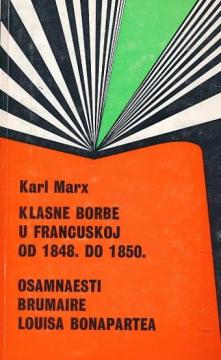
Klasne borbe u Francuskoj 1848-1850.

A Marxist analysis of the revolutionary events in France from the February Revolution of 1848 to 1850. Marx explains the economic-class conflicts that led to the establishment of the dictatorship of the bourgeoisie.
Karl Marx’s work The Class Struggles in France, 1848–1850 stands as one of the foundational texts of historical materialism, in which the author applies his theory to specific socio-political events. Through a series of articles written in 1850, Marx provides a detailed analysis of the causes, course, and consequences of the February Revolution of 1848, the collapse of the provisional government, the June Uprising of the Parisian working class, and the rise of Louis Bonaparte. The central thesis of the work is that political struggles are, at their core, a reflection of the economic interests and conflicts of various classes: the financial aristocracy, the industrial bourgeoisie, the petty bourgeoisie, the peasantry, and the proletariat. Marx identifies the bloody suppression of the workers' June Uprising as a turning point that exposed the true nature of bourgeois demagoguery and demonstrated that a compromise between labor and capital is impossible. This work is of immense significance, as it marks the first instance in which Marx clearly articulates the concept of the "dictatorship of the proletariat" as a necessary transitional phase toward a classless society. The text offers profound insight into the mechanisms of political upheaval and the role of economic crises in revolutions, remaining an essential read for understanding the political theory of Marxism.
Jedan primerak je u ponudi