Gustave Flaubert
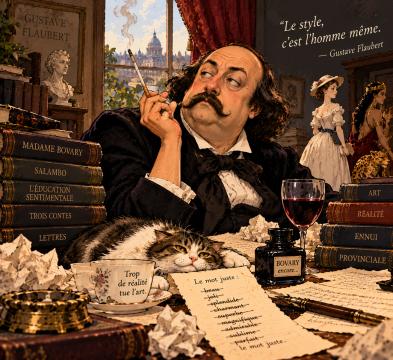
Gustave Flaubert (Rouen, December 12, 1821 – Croisset, May 8, 1880) was a French writer and a key figure of European realism. The son of a prominent surgeon, he grew up in Rouen and began studying law in Paris in the 1840s. He did not complete his studies, however, and instead retired to the family estate in Croisset, where he devoted most of his life to literature. He traveled across Europe, Egypt, and the Middle East, later drawing upon the experiences gained during these journeys for his literary works.
Flaubert viewed literature as a demanding artistic discipline. He was known for his almost obsessive attention to style, sentence rhythm, and the pursuit of the precise expression—the famous le mot juste (the right word). His prose combines realistic social observation with irony, psychological analysis, and exceptional stylistic refinement.
He achieved worldwide fame with the novel Madame Bovary (1857), the story of Emma Bovary, a provincial woman whose romantic ideals clash with the banality of everyday life. Following the novel's publication, Flaubert was brought to trial for an alleged offense against public morality but was acquitted. The work soon became a cornerstone of French realist fiction.
Next came the historical novel Salammbô (1862), set in ancient Carthage, followed by Sentimental Education (1869), a sweeping portrait of French society and the disillusionment of the generation surrounding the Revolution of 1848. In 1874, he published The Temptation of Saint Anthony—a work he had labored over for decades—and in 1877, the collection Three Tales, comprising "A Simple Heart," "The Legend of Saint Julian the Hospitaller," and "Herodias."
He devoted his final years to the satirical novel Bouvard and Pécuchet, which remained unfinished and was published posthumously. An important part of his legacy is his extensive correspondence, which is invaluable for understanding his creative process and his views on literature.
Flaubert’s ideal of precise, objective, and stylistically disciplined prose exerted a powerful influence on later realism and the modern novel. Madame Bovary, Sentimental Education, and his short stories remain among the most significant works of 19th-century French literature.
Naslovi u ponudi

Gospođa Bovari
Ovo je vrsna romaneskna priča o neuspjelom braku, preljubima bez strasti i samoubojstvu mlade žene koja je maštala o uzbudljivom životu, uzalud čekajući promjenu u malograđanskoj svakodnevici.
Gospođa Bovari
Ovaj roman prati priču o Emi Bovari, mladoj i sanjalačkoj ženi koja je zarobljena u nezadovoljavajućem braku sa seoskim lekarom, Šarlem Bovarijem.
Madam Bovari
Madame Bovary ist ein Meisterwerk des berühmten französischen Schriftstellers Gustave Flaubert und ein Klassiker der Weltliteratur. Der 1857 veröffentlichte Roman erzählt die tragische Geschichte von Emma Bovary, einer Frau, die mit ihrem Leben auf dem fr

Madame Bovary
Emma Bovary, die Frau eines Provinzarztes, sucht das romantische Glück in Liebesaffären und Luxus. Ihre Träume kollidieren mit der Realität und führen zum Ruin.

Sentimentalni odgoj: Povijest mladog čovjeka
Sentimentale Erziehung ist ein Roman von Gustave Flaubert über die zersetzende Wirkung der Zeit auf jugendliche Illusionen.