Winston Churchill
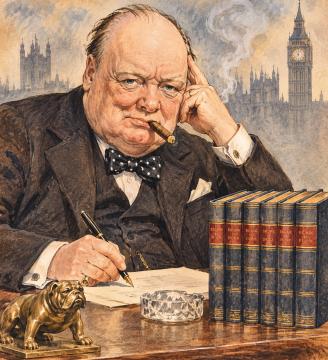
Sir Winston Leonard Spencer Churchill (30 November 1874 – 24 January 1965) was a British statesman, politician, soldier, journalist, historian and writer, and one of the most influential political figures of the twentieth century. Born at Blenheim Palace into the aristocratic Spencer-Churchill family, he was educated at the Royal Military Academy Sandhurst.
He began his career as an army officer and war correspondent, participating in military campaigns in India, Sudan and South Africa. Elected to the British Parliament in 1900, he held numerous senior government positions throughout his extensive political career.
Churchill achieved his greatest historical prominence as British Prime Minister during the Second World War (1940–1945), when his speeches, political leadership and diplomatic efforts contributed to Britain's resistance to Nazi Germany and the Allied victory. He served a second term as prime minister from 1951 to 1955. His political outlook was characterised by British imperialism, anti-communism and the defence of parliamentary democracy, alongside controversial attitudes towards colonial peoples.
Churchill produced an extensive literary oeuvre encompassing historical studies, memoirs, biographies, political essays and speeches. His best-known work, the six-volume The Second World War (1948–1953), is a monumental account of wartime events, international diplomacy and political decision-making.
His other major works include The River War (1899), The World Crisis (1923–1931), My Early Life (1930), Marlborough: His Life and Times (1933–1938) and the four-volume A History of the English-Speaking Peoples (1956–1958).
In 1953, Churchill was awarded the Nobel Prize in Literature for his mastery of historical and biographical writing and his exceptional oratory in defence of human values. His writings remain an important part of twentieth-century political literature, memoirs and historiography, offering valuable insights into British and international history.
Naslovi u ponudi

Drugi svetski rat I: Bura se sprema
Churchill prati put od mira nakon Prvoga svjetskog rata do novoga sukoba i krize 1940., analizirajući Hitlerov uspon, politiku popuštanja i propuštene prilike da se spriječi europska katastrofa.

Drugi svetski rat III: Velika alijansa
Churchill prikazuje ratnu 1941.: borbe na Balkanu, u Africi i na Atlantiku, napad na SSSR i Pearl Harbor te nastanak velike koalicije Britanije, Sovjetskog Saveza i SAD-a protiv sila Osovine.

Drugi svetski rat II: Njihov najlepši trenutak
Churchill opisuje presudne mjesece 1940.: slom Francuske, evakuaciju iz Dunkerquea, bitku za Britaniju i bombardiranje gradova, otkrivajući odluke i napore kojima je održan britanski otpor Hitleru.

Drugi svetski rat IV: Prekretnica sudbine
Od pada Singapura i poraza u Africi do Midwaya, El Alameina i Staljingrada, Churchill prati preokret 1942.–1943., kada saveznici zaustavljaju napredovanje sila Osovine i postupno preuzimaju inicijativu.

Drugi svetski rat VI: Trijumf i tragedija
Od Normandije do poraza Njemačke i Japana, Churchill prati završnicu rata i pregovore o miru, otkrivajući kako savezničku pobjedu prate raspad koalicije, podjela Europe i nova politička suparništva.

Drugi svetski rat V: Obruč se steže
Churchill prati savezničko napredovanje 1943.–1944.: iskrcavanje na Siciliji, slom Mussolinija, borbe u Italiji i pripreme za Normandiju, uz pregovore koji određuju strategiju i budućnost Europe.