Winston Churchill
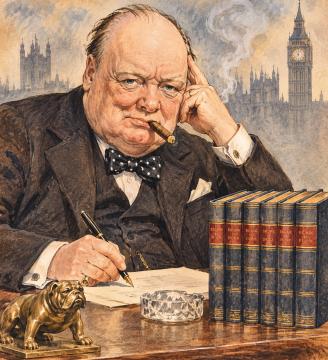
Sir Winston Leonard Spencer Churchill (30 November 1874 – 24 January 1965) was a British statesman, politician, soldier, journalist, historian and writer, and one of the most influential political figures of the twentieth century. Born at Blenheim Palace into the aristocratic Spencer-Churchill family, he was educated at the Royal Military Academy Sandhurst.
He began his career as an army officer and war correspondent, participating in military campaigns in India, Sudan and South Africa. Elected to the British Parliament in 1900, he held numerous senior government positions throughout his extensive political career.
Churchill achieved his greatest historical prominence as British Prime Minister during the Second World War (1940–1945), when his speeches, political leadership and diplomatic efforts contributed to Britain's resistance to Nazi Germany and the Allied victory. He served a second term as prime minister from 1951 to 1955. His political outlook was characterised by British imperialism, anti-communism and the defence of parliamentary democracy, alongside controversial attitudes towards colonial peoples.
Churchill produced an extensive literary oeuvre encompassing historical studies, memoirs, biographies, political essays and speeches. His best-known work, the six-volume The Second World War (1948–1953), is a monumental account of wartime events, international diplomacy and political decision-making.
His other major works include The River War (1899), The World Crisis (1923–1931), My Early Life (1930), Marlborough: His Life and Times (1933–1938) and the four-volume A History of the English-Speaking Peoples (1956–1958).
In 1953, Churchill was awarded the Nobel Prize in Literature for his mastery of historical and biographical writing and his exceptional oratory in defence of human values. His writings remain an important part of twentieth-century political literature, memoirs and historiography, offering valuable insights into British and international history.
Naslovi u ponudi

Drugi svetski rat I: Bura se sprema
Churchill traces the road from the peace after the First World War to renewed conflict and the crisis of 1940, examining Hitler’s rise, appeasement and missed opportunities to prevent catastrophe.

Drugi svetski rat III: Velika alijansa
Churchill recounts 1941: fighting in the Balkans, Africa and the Atlantic, Germany’s invasion of the USSR, Pearl Harbor and the formation of the alliance between Britain, the Soviet Union and the USA.

Drugi svetski rat II: Njihov najlepši trenutak
Churchill recounts the decisive months of 1940: France’s collapse, Dunkirk, the Battle of Britain and the Blitz, revealing the decisions and efforts that sustained British resistance to Hitler.

Drugi svetski rat IV: Prekretnica sudbine
From Singapore’s fall and defeats in Africa to Midway, El Alamein and Stalingrad, Churchill traces the turning point of 1942–1943, as the Allies halt Axis expansion and gradually seize the initiative.

Drugi svetski rat VI: Trijumf i tragedija
From Normandy to the defeat of Germany and Japan, Churchill follows the war’s final stages and peace negotiations, revealing how Allied victory gives way to a fractured coalition and a divided Europe.

Drugi svetski rat V: Obruč se steže
Churchill follows the Allied advance in 1943–1944: Sicily, Mussolini’s fall, the Italian campaign and preparations for Normandy, alongside negotiations shaping military strategy and Europe’s future.