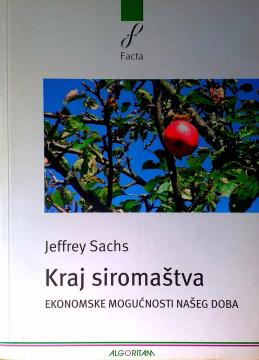
Kraj siromaštva: Ekonomske mogućnosti našeg doba

Kraj siromaštva: Ekonomske mogućnosti našeg doba

Jeffrey Sachs

In the book, economist Jeffrey Sachs presents an optimistic plan for eliminating extreme poverty by 2025. He argues that this is feasible with political will, because world wealth is growing, and poverty is not fate, but the result of inefficient systems.

Sachs introduces "clinical economics" - a systematic approach to treating a disease: diagnosis of the problem, prescription (interventions), and monitoring. He focuses on the poorest countries in Africa, Asia, and Latin America, where billions of people live on less than $1 a day. Key causes: geographical barriers (tropical diseases, droughts), lack of investment in infrastructure, education, and health, and political instability.

He proposes a three-pronged plan: (1) Urgent aid for the "big fight" - networks for malaria prevention, AIDS, distribution of seeds and fertilizers for agriculture; (2) Long-term development - building roads, schools, clinics; (3) Global cooperation - increasing support from rich countries to 0.7% of GDP for development aid, debt cancellation, and non-discriminatory trade rules.

The book is replete with case studies: Sachs's success in Bolivia (1985, hyperinflation stopped), Poland (shock therapy), and Zambia (malaria controlled). He criticizes the West for ineffective aid and calls for support for the Millennium Development Goals of the UN. It concludes that poverty is not inevitable – with $175 billion a year (less than 1% of global GDP) we can save lives, prevent wars and boost growth.

Sachs's vision is inspiring, but critics warn of the risks of dependence on aid. Nevertheless, the book remains a manifesto of humanism in economics.

Titel des Originals
The End of Poverty: Economic Possibilities for Our Time
Übersetzung
Nebojša Buđanovac
Editor
Irena Miličić
Maße
23 x 17 cm
Seitenzahl
450
Verlag
Algoritam, Zagreb, 2007.
 
Latein Schrift. Taschenbuch.
Sprache: Kroatisch.

Angeboten wird ein Exemplar

Zustand:Gebraucht, in ausgezeichnetem Zustand
Zum Warenkorb hinzugefügt!
 

Interessieren Sie sich für ein anderes Buch? Sie können das Angebot über unsere Suchmaschine suchen und finden oder Bücher nach Kategorien durchsuchen.

Diese Titel könnten Sie auch interessieren

Što je čuvalo nadu

Što je čuvalo nadu

Boris Maruna

Boris Maruna, a poet and essayist, has carried the burden of a history that has been silenced and entrusted to myth since his early youth. He carried this burden in his poems, but also in his essayistic prose, which is brought together for the first time

Matica hrvatska, 2008.
Kroatisch. Latein Schrift. Fester Einband mit Schutzumschlag.
15,98
Hrvatsko ratno pismo 1991/92. - apeli, iskazi, pjesme / Croatian war writing 1991/92 - appeals, viewpoints, poems

Hrvatsko ratno pismo 1991/92. - apeli, iskazi, pjesme / Croatian war writing 1991/92 - appeals, viewpoints, poems

Dubravka Oraić-Tolić

The book presents a chronology of intellectual and civil resistance during the homeland war. Compare the Croatian text and the English translation.

Filozofski fakultet Sveučilišta u Zagrebu, 1992.
Kroatisch. Latein Schrift. Fester Einband mit Schutzumschlag.
17,56
Gospođa tužiteljica (Carla Del Ponte)

Gospođa tužiteljica (Carla Del Ponte)

Carla del Ponte, Chuck Sudetic
Profil International, 2008.
Kroatisch. Latein Schrift. Taschenbuch.
3,46
Za svest

Za svest

Nolit, 1977.
Serbisch. Latein Schrift. Taschenbuch.
5,26 - 5,36
Zašto smo se rastali

Zašto smo se rastali

Tanja Torbarina
Centar za informacije i publicitet (CIP), 1990.
Kroatisch. Latein Schrift. Fester Einband mit Schutzumschlag.
12,36
Priznanje (jedno iskustvo sa procesa u Pragu)

Priznanje (jedno iskustvo sa procesa u Pragu)

Artur London

This book provides an insight into the political repressions of the time and the personal suffering the author went through.

Prosveta, 1969.
Serbisch. Kyrillisch Schrift. Taschenbuch.
8,52