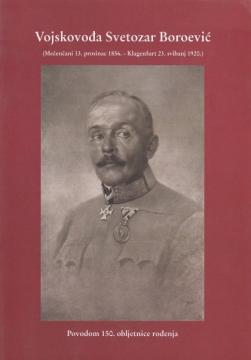
Vojskovođa Svetozar Boroević 1856-1920.

Vojskovođa Svetozar Boroević 1856-1920.

Milan Pojić

Svetozar Boroević, the most capable Austro-Hungarian military leader of the First World War, the only Croat who received the title of field marshal and was awarded the highest Austrian decorations, has been systematically hushed up in Croatian history.

"Ignorance of the basic facts about Svetozar Boroević, and even more the assessment of his person and works by the politicians of the subsequent state formations in which Croatia found itself, from monarchist to socialist Yugoslavia, turned the great military leader and Croatian patriot into a victim of stereotypes. The first, and a similar fate followed ban Josip Jelačić for a long time, is that Boroević is more of an imperial/Austro-Hungarian general and military leader, and less of a "Croatian/Yugoslav patriot". He cares more about the salvation of the Monarchy than about the interests of the Croatian homeland and the Croatian people. Another stereotype is that he was born into an Orthodox border family, so he is therefore a Serb. This stereotype, which was very successfully promoted by the Serbian Orthodox Church and accepted by the wider Croatian public, led to the fact that in the last biography of Boroević published in 1989 in the Croatian Biographical Lexicon, the Miroslav Krleža Lexicographic Institute in Zagreb considered it necessary to mention that Boroević was "of origin is from a Serbian border family". None of the above stereotypes is correct."

Übersetzung
Danijela Marjanić
Maße
24 x 17 cm
Seitenzahl
31
Verlag
Hrvatski državni arhiv, Zagreb, 2006.
 
Latein Schrift. Taschenbuch.
Sprache: Kroatisch.

Angeboten wird ein Exemplar

Zustand:Gebraucht, in ausgezeichnetem Zustand
Zum Warenkorb hinzugefügt!
 

Interessieren Sie sich für ein anderes Buch? Sie können das Angebot über unsere Suchmaschine suchen und finden oder Bücher nach Kategorien durchsuchen.

Diese Titel könnten Sie auch interessieren

Osječka groblja

Osječka groblja

Stjepan Sršan

The book is deeply rooted in the local history and culture of Osijek, with an emphasis on cemetery motifs that serve as a metaphor for memory, death, and disappearance.

Povijesni arhiv u Osijeku, 1996.
Kroatisch. Latein Schrift. Taschenbuch.
5,26
Maslinov vijenac 6

Maslinov vijenac 6

Drago Štambuk

The publication contains verses from poets awarded with the Olive Wreath at the Croatia Rediviva Heritage Days held in Selce on Brač from 2016-2020.

Croatia rediviva, 2021.
Kroatisch. Latein Schrift. Taschenbuch.
16,84
Istočna Hrvatska: Osijek – Vukovar – Ilok (zbornik radova)

Istočna Hrvatska: Osijek – Vukovar – Ilok (zbornik radova)

The collection contains papers from the international scientific conference, Eastern Croatia: Osijek – Vukovar – Ilok, held in 1999.

Pedagoški fakultet, 2002.
Kroatisch. Latein Schrift. Taschenbuch.
7,98
U obrani obespravljenih: izbor iz dokumenata banjalučkog biskupa i Biskupskog ordinarijata Banjaluka tijekom ratnih godina od 1991. do 1995.

U obrani obespravljenih: izbor iz dokumenata banjalučkog biskupa i Biskupskog ordinarijata Banjaluka tijekom ratnih godina od 1991. do 1995.

The book In Defense of the Disenfranchised Bishops by Franjo Komarica is a collection of around 300 documents, letters, appeals and statements published by the Bishop of Banja Luka and the Episcopal Ordinariate of Banja Luka during the war years from 1991

Nakladni zavod Matice hrvatske, 2003.
Kroatisch. Latein Schrift. Hardcover.
12,42
Balada o Nikoli Gorjanskom

Balada o Nikoli Gorjanskom

Vlado Nemet
Tilia, 1994.
Kroatisch. Latein Schrift. Hardcover.
2,98
Hrvatsko domobranstvo u Drugom svjetskom ratu

Hrvatsko domobranstvo u Drugom svjetskom ratu

Ivan Košutić

The book provides a detailed account of the development, organization, and operations of the Croatian Home Guard, the regular army of the Independent State of Croatia (NDH), in the period from 1941 to 1945.

Nakladni zavod Matice hrvatske, 1992.
Kroatisch. Latein Schrift. Fester Einband mit Schutzumschlag.
11,56